Best DIY Balcony Solar Kits for Apartments and Renters (2026 Guide)
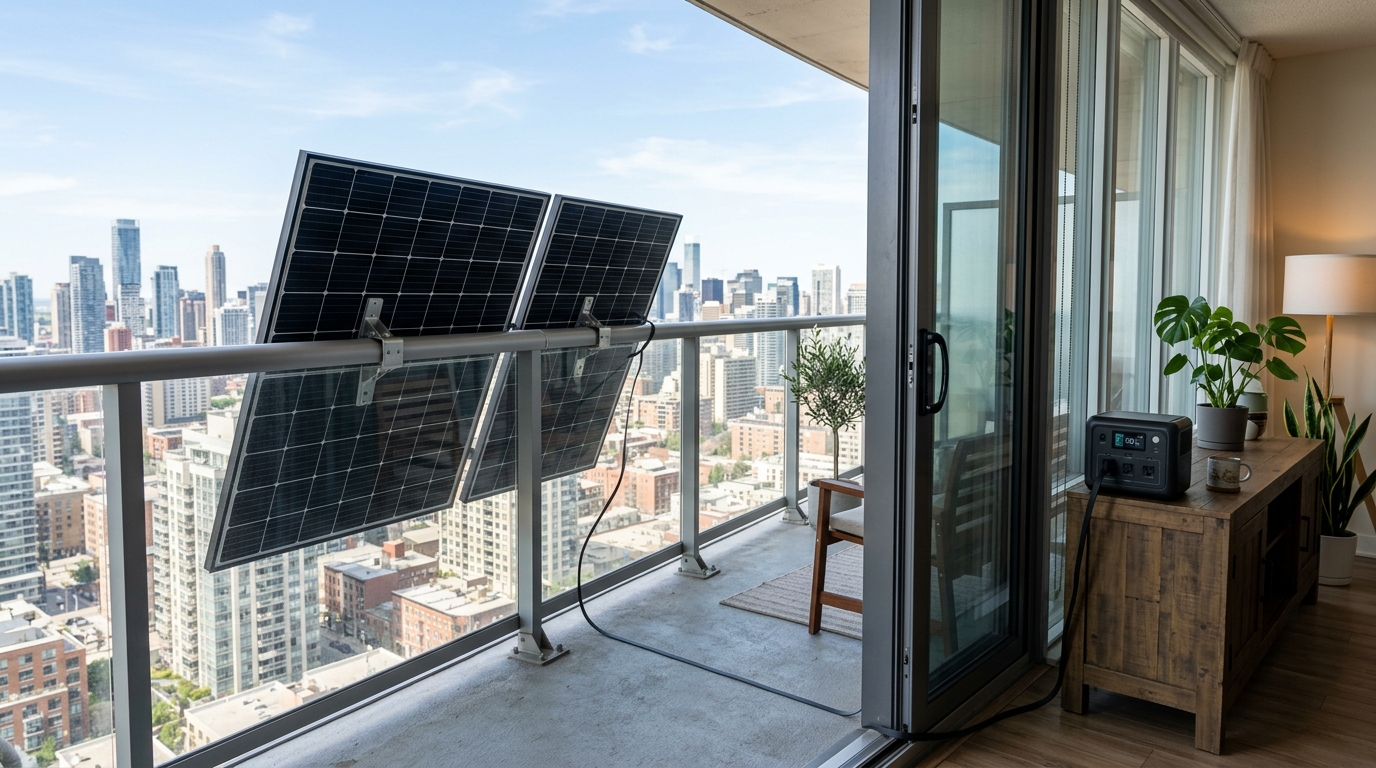
Balcony solar panels allow apartment dwellers and renters to generate clean, independent electricity without drilling or landlord conflicts.
By WattDweller Editorial Team · Updated October 17, 2026
For decades, generating your own solar electricity required two things most urban residents do not have: deed ownership of a private roof and thousands of dollars in commercial contracting capital. If you lived in a rental apartment, condominium, or multi-family complex, green energy felt completely out of reach.
That landscape has changed dramatically. Across Europe and now rapidly expanding throughout North America, a grassroots energy movement known as balcony solar or plug-in solar is empowering apartment residents to generate their own clean electricity.
By mounting lightweight, high-efficiency monocrystalline solar panels to a private balcony railing or patio ledge, you can capture free sunlight and route that electricity directly into your home. Paired with compact, drill-free window pass-through cables and modern lithium storage batteries, you can power your home office, run circulation fans, recharge mobile electronics, and buffer your kitchen refrigerator against rising utility rates.
Best of all for renters: the entire system is one hundred percent non-invasive. You do not drill holes in exterior stucco, you do not modify building wiring, and you do not risk losing your security deposit. When your lease ends, the entire setup unclamps in twenty minutes, packs neatly into your vehicle, and moves with you to your next home.
In this comprehensive guide, we review the best DIY balcony solar kits, folding monocrystalline panels, and companion storage hardware for apartment living. We evaluate railing safety standards, calculate realistic monthly kilowatt-hour yields, and show you how to start generating your own power for less than the cost of a modern smartphone.
For an exhaustive technical breakdown of full off-grid systems, micro wind turbines, and advanced charge controllers, explore our cornerstone pillar manual: Achieve Energy Independence: DIY Solar, Wind, and Alternative Energy Solutions.
How Balcony Solar Works for Renters
Understanding the mechanics of a renter-friendly solar setup demystifies the entire process. Traditional rooftop solar systems back-feed high-voltage alternating current through a permanent connection into a building breaker panel. In contrast, a self-contained apartment balcony system operates as an independent, closed micro-generation circuit:
+--------------------------------------------------------------------------+
|                     APARTMENT BALCONY SOLAR ARCHITECTURE                 |
|                                                                          |
|  [OUTDOOR BALCONY]                                                       |
|  - Monocrystalline Panels clamped to railing with safety tethers         |
|  - Standard MC4 waterproof connections                                   |
|                          │                                               |
|                          ▼                                               |
|  [WINDOW / DOOR PASS-THROUGH]                                            |
|  - Ultra-thin flat ribbon cable slides under closed sliding glass door   |
|  - Weatherstrip seals remain 100% intact with zero air or water leaks    |
|                          │                                               |
|                          ▼                                               |
|  [INDOOR LIVING ROOM]                                                    |
|  - Portable Power Station with integrated MPPT charge controller         |
|  - Direct DC to AC pure sine wave power for daily apartment appliances   |
+--------------------------------------------------------------------------+
Because stored energy flows directly from your battery to your personal electronics and appliances, you completely bypass the utility grid. You generate electricity during peak daylight hours, store it safely in high-efficiency Lithium Iron Phosphate (LiFePO4) cells, and deploy it whenever utility rates surge or storms trigger neighborhood blackouts.
Quick Comparison: Top Balcony Solar Hardware for 2026
Before examining detailed reviews, compare our top hardware selections across wattage, form factor, and apartment deployment suitability:
| Product | Wattage Rating | Panel Type | Weight | Primary Advantage | Best For |
|---|---|---|---|---|---|
| Renogy 100W Starter Kit | 100 Watts | Rigid Monocrystalline | 14.1 lbs | Complete all-in-one kit with 30A LCD controller | Best Complete Educational Starter Pack |
| Renogy 200W Portable Panel | 200 Watts | Folding N-Type Monocrystalline | 26.5 lbs | Premium 23%+ efficiency, adjustable kickstands | Best High-Efficiency Balcony Performer |
| EcoFlow DELTA 2 | 1,024Wh Storage | Companion LiFePO4 Station | 27.0 lbs | 500W solar input, runs full-size refrigerator | Best All-Day Appliance Storage Hub |
| EcoFlow RIVER 2 | 256Wh Storage | Companion LiFePO4 Station | 7.7 lbs | Ultra-compact, 110W solar input, 60-min wall top-off | Best Budget Desktop & CPAP Storage |
| BLUETTI EB3A | 268Wh Storage | Companion LiFePO4 Station | 10.1 lbs | Muscular 600W AC inverter plus wireless phone pad | Best Feature-Dense Value Companion |
The 4-Step Balcony Solar Feasibility Audit
Before ordering solar panels, evaluate your apartment living space against these four fundamental environmental criteria:
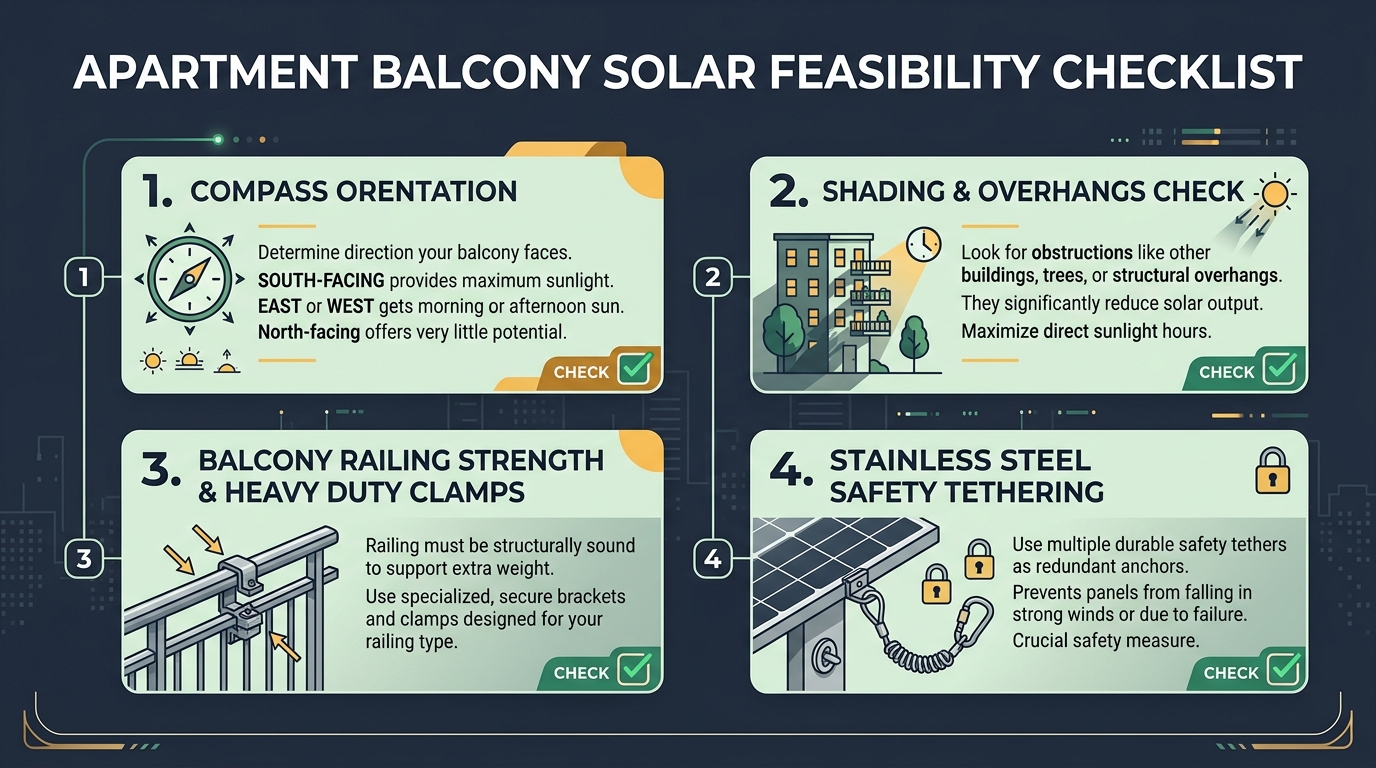
Evaluate sunlight angles, railing dimensions, and secondary safety tethering before assembling hardware.
1. Compass Orientation and Sunlight Exposure
Photovoltaic efficiency depends directly on the angle and duration of direct sunlight hitting your panels:
- South-Facing Balconies (Ideal): Receive direct sunlight throughout the peak generation window between 10:00 AM and 3:00 PM. A 200-watt array mounted south can generate 600 to 900 watt-hours of electricity daily.
- East-Facing Balconies (Good): Capture intense morning sunlight. Highly productive for recharging overnight battery depletion before midday.
- West-Facing Balconies (Good): Absorb strong afternoon sun, capturing energy precisely when regional electric utility rates reach peak pricing brackets.
- North-Facing Balconies (Poor): Receive only indirect ambient light. Photovoltaic yields drop by seventy to eighty percent, making solar investment uneconomical.
2. Shading and Structural Overhangs
Take thirty seconds to step onto your balcony at 9:00 AM, 12:00 PM, and 3:00 PM. Note whether upper-floor balconies, structural eaves, mature trees, or neighboring high-rises cast hard shadows across your railing. Even a partial shadow covering twenty percent of a solar panel can reduce total array output by half due to internal cell string resistance.
3. Railing Strength and Mechanical Attachment
Balcony railings must support wind resistance as well as physical panel weight. A standard 100-watt rigid panel weighs approximately fourteen pounds and acts like a small sail during high-wind gusts:
- Ensure your balcony railing features sturdy vertical metal spindles or solid masonry framing.
- Always employ dual-point clamping brackets rated for outdoor structural loads.
- Never rely on plastic zip-ties or temporary bungee cords as primary mounting hardware.
4. Secondary Safety Tethering
Safety in multi-story buildings is paramount. Whenever you mount any hardware to an elevated balcony railing, install an independent stainless steel safety tether connecting the panel frame directly to the primary balcony post. If a primary mounting clamp ever loosens or fails during an extreme storm gust, the safety cable prevents the panel from falling to the street below.
⚠️ Important Safety Rule: Always secure outdoor solar hardware with secondary braided stainless steel aircraft cables rated for at least one hundred pounds. Safety tethering protects pedestrians below and guarantees compliance with municipal multi-family dwelling safety codes.
Top Tested Hardware for Balcony Solar Systems
1. Best Complete Starter System: Renogy 100 Watt 12V Starter Kit
Renogy 100 Watt 12 Volt Solar Starter Kit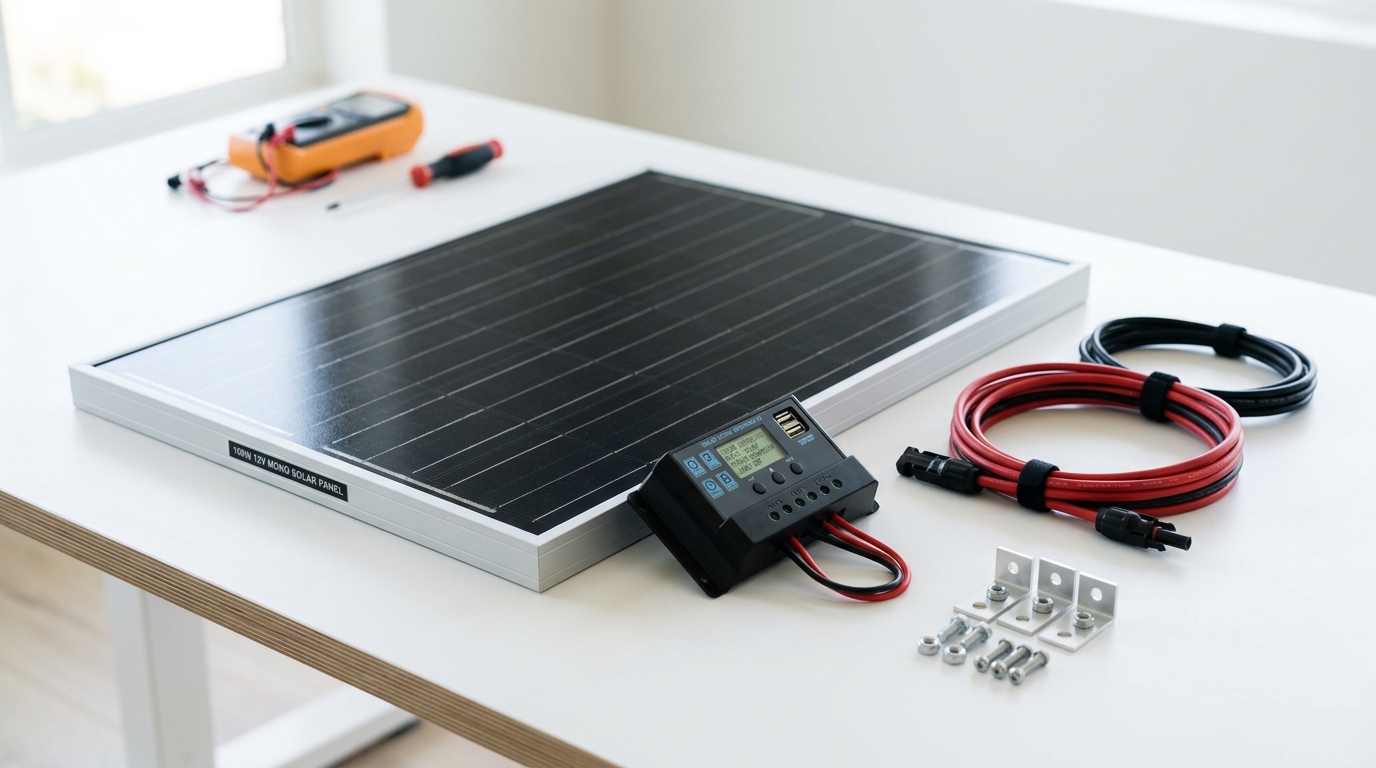
The Renogy 100W starter kit provides an accessible, expandable foundation for understanding solar power hands-on.
If you want an affordable, thoroughly tested entry point into solar power, the Renogy 100 Watt Starter Kit is the gold standard educational and practical package.
The kit bundles a premium Grade-A monocrystalline panel with an intuitive 30-amp PWM charge controller featuring an informative digital LCD display, heavy-duty mounting Z-brackets, and twenty feet of 10 AWG solar adapter cable. The panel frame is constructed from corrosion-resistant extruded aluminum that withstands heavy snow loads and wind pressures up to 2,400 Pascals.
Mounted vertically or angled outward on an apartment railing, this single 100-watt panel captures between 350 and 500 watt-hours of clean electricity on a typical sunny day. That is enough free energy to recharge a smartphone thirty times, keep a laptop operating through an eight-hour remote workday, or power indoor emergency LED lighting indefinitely.
Because the included 30-amp charge controller supports up to 400 watts of total input, your system can expand as your needs grow. When you decide to add more power, you simply mount additional panels in parallel without purchasing new control electronics.
Key Specifications:
- Rated Power: 100 Watts Monocrystalline
- Open Circuit Voltage (Voc): 21.6 Volts
- Optimum Operating Current (Imp): 5.75 Amps
- Dimensions: 42.2 x 19.6 x 1.38 inches
- Weight: 14.1 pounds
Renter Suitability:
- The Good: Complete out-of-the-box package; clear digital LCD screen shows real-time charging amperes; expandable up to four panels.
- The Tradeoff: Rigid aluminum frame requires dedicated railing clamping brackets.
- Best For: Beginners seeking a dependable, educational solar circuit for small apartment emergency backup and battery maintenance.
2. Best High-Efficiency Folding Panel: Renogy 200 Watt Portable Monocrystalline Solar Panel
Renogy 200 Watt Portable Monocrystalline Solar PanelFor renters who want substantial power generation without bolting rigid frames to their railing, this 200-watt folding monocrystalline suitcase is a technological triumph.
Built around high-performance N-Type monocrystalline cells with conversion efficiency exceeding twenty-three percent, this panel folds like a slim brief-case equipped with heavy-duty carrying handles and adjustable aluminum kickstands. You simply carry the panel onto your balcony in the morning, fold out the kickstands to track the sun angle, and fold it back up when you leave for work or when rain clouds gather.
Adjusting the kickstand legs allows you to position the surface at twenty, thirty, or forty-five degrees, extracting up to thirty percent more daily energy than panels mounted flat against a vertical railing. Equipped with standard MC4 waterproof connectors, it pairs effortlessly with flat window pass-through cables and portable battery stations.
During a full clear day, this single 200-watt array captures between 700 and 1,000 watt-hours of fresh energy, enough to replenish a full-sized portable power station and run essential household electronics completely off-grid.
Key Specifications:
- Rated Power: 200 Watts
- Cell Type: High-Efficiency N-Type Monocrystalline (23%+ efficiency)
- Design: Folding suitcase with built-in adjustable kickstands
- Weight: 26.5 pounds
- Connector Type: Standard MC4 Waterproof Connectors
Renter Suitability:
- The Good: Zero permanent installation required; adjustable sun angles maximize energy capture; packs away into a closet in thirty seconds.
- The Tradeoff: Weighs 26.5 pounds, requiring careful handling when moving through narrow sliding balcony doors.
- Best For: Renters with spacious balconies or ground-floor patios seeking maximum daily kilowatt-hours without mechanical railing brackets.
Ideal Battery Storage Companions for Balcony Solar
Generating solar energy on your balcony provides immediate value only if you have a safe, high-capacity battery to store that power. Modern portable power stations serve as the ideal storage companion for apartment solar, eliminating the need to wire separate lead-acid blocks, inverters, and fuse holders in your living room:
+-------------------------------------------------------------------------------+
|             TOP BATTERY COMPANIONS FOR BALCONY SOLAR ARRAYS                   |
+------------------------+---------------------+--------------------------------+
| Metric                 | EcoFlow DELTA 2     | EcoFlow RIVER 2                |
+------------------------+---------------------+--------------------------------+
| Storage Capacity       | 1,024Wh (LiFePO4)   | 256Wh (LiFePO4)                |
| Max Solar Input        | 500 Watts (11V-60V) | 110 Watts (11V-30V)            |
| Solar Recharge Time    | 2 to 3 hrs (with 200W)| 2.5 to 3 hrs (with 100W)     |
| Continuous AC Output   | 1,800 Watts         | 300 Watts                      |
| Appliance Capabilities | Refrigerator, TV, PC| Laptops, Phones, Wi-Fi, CPAP   |
| Physical Weight        | 27.0 pounds         | 7.7 pounds                     |
+------------------------+---------------------+--------------------------------+
1. Best All-Day Appliance Storage: EcoFlow DELTA 2
EcoFlow DELTA 2 Portable Power Station (1024Wh)The EcoFlow DELTA 2 is the premier storage partner for 200-watt to 400-watt balcony solar arrays. It features an integrated high-efficiency MPPT solar charge controller that accepts up to 500 watts of solar input across a wide 11V to 60V voltage range.
Paired with the Renogy 200W portable panel, the DELTA 2 absorbs power rapidly throughout sunny mornings, storing enough electricity to operate a full-sized kitchen refrigerator for eight to twelve hours overnight. Its 1,800-watt pure sine wave AC inverter powers microwave ovens, blenders, and entertainment centers without hesitation.
For full apartment backup testing and runtime data, read our dedicated review: Best Portable Power Stations for Apartments: Safe, Quiet Indoor Backup.
🛒 Check EcoFlow DELTA 2 Price on Amazon2. Best Compact Desktop Storage: EcoFlow RIVER 2
EcoFlow RIVER 2 Portable Power Station (256Wh)For smaller balconies where space allows only a single 100-watt panel, the EcoFlow RIVER 2 is the ultimate lightweight companion. Weighing just 7.7 pounds, it accepts up to 110 watts of solar input, charging from empty to full in under three hours of midday sunlight.
Its 256 watt-hours of durable LiFePO4 battery capacity powers a home Wi-Fi modem and laptop workstation through a full day of remote work. When you travel on weekend camping trips, you simply unplug the panel and take the lightweight battery with you.
🛒 Check EcoFlow RIVER 2 Price on Amazon3. Best Feature-Dense Budget Pick: BLUETTI EB3A
BLUETTI Portable Power Station EB3A (268Wh)The BLUETTI EB3A packs 268 watt-hours of storage with an unusually potent 600-watt inverter, allowing it to handle small kitchen appliances and desktop PC rigs that overwhelm basic 300-watt batteries.
With a built-in 200-watt MPPT solar controller, it pairs flawlessly with 100-watt and 200-watt folding panels. The integrated 15-watt wireless Qi charging pad on top provides effortless smartphone recharging right at your desk. For a direct head-to-head evaluation against competing brands, consult our detailed comparison: EcoFlow vs Jackery vs Bluetti: Which Power Station Is Best for Blackouts?.
🛒 Check BLUETTI EB3A Price on AmazonThe Essential Non-Invasive Renter Toolkit
Setting up balcony solar without drilling exterior walls or damaging window weatherstripping requires a few inexpensive, specialized accessories. These low-cost components ensure your installation remains completely reversible and landlord-friendly:
+--------------------------------------------------------------------------+
|                     NON-INVASIVE RENTER HARDWARE ESSENTIALS              |
|                                                                          |
|  1. Flat Ribbon Window Pass-Through Cables ($15 to $25)                  |
|     - Ultra-thin copper laminate slides through closed sliding doors     |
|     - Zero drilling, preserves weather sealing, waterproof exterior      |
|                                                                          |
|  2. Heavy-Duty Balcony Railing Clamps & Brackets ($25 to $45)            |
|     - Anodized aluminum clamps wrap around round or square spindles      |
|     - Adjustable tilt angles (20 to 45 degrees), protective rubber pads  |
|                                                                          |
|  3. Braided Stainless Steel Safety Tethers ($10 to $15)                  |
|     - 100 lb tensile strength, secondary drop prevention protection      |
|                                                                          |
|  4. MC4 Inline DC Fuses & Disconnect Wrenches ($10 to $18)               |
|     - Overcurrent protection, rapid tool-free maintenance disconnects    |
+--------------------------------------------------------------------------+
The Flat Window Pass-Through Cable: The Renter Secret Weapon
How do you route DC electricity from an outdoor balcony panel to an indoor battery without leaving your balcony door open or drilling holes in the window frame?
The answer is an ultra-thin flat ribbon solar cable. These specialized cables utilize flattened multi-strand copper conductors encased in durable, weather-sealed polymer jackets measuring less than two millimeters in thickness.
You place the flat section along the bottom sill of your sliding glass door or casement window, close the door completely over it, and engage the deadbolt latch. The flexible cable conforms to the rubber door weatherstripping, allowing the door to lock securely while completely preventing drafts, rain, or insects from entering your apartment.
Real-World Production: How Much Electricity Can You Actually Make?
Managing expectations is vital in alternative energy planning. A 200-watt balcony solar array will not power a central air conditioning unit or electric clothes dryer. However, when deployed strategically, it generates meaningful, consistent energy yields that noticeably lower your utility expenses.
+-------------------------------------------------------------------------------+
|             MONTHLY BALCONY SOLAR PRODUCTION ESTIMATES (200W ARRAY)           |
+----------------------+--------------------+-------------------+---------------+
| Region & Season      | Avg Daily Sun Hours| Daily Harvest     | Monthly Yield |
+----------------------+--------------------+-------------------+---------------+
| Southwest US / Summer| 5.5 to 6.5 Hours   | 850 to 1,010 Wh   | 25 to 30 kWh  |
| Midwest / Spring-Fall| 4.0 to 4.8 Hours   | 620 to 750 Wh     | 18 to 22 kWh  |
| Northeast / Winter   | 2.5 to 3.2 Hours   | 390 to 500 Wh     | 11 to 15 kWh  |
| Pacific NW / Winter  | 2.0 to 2.8 Hours   | 310 to 430 Wh     | 9 to 13 kWh   |
+----------------------+--------------------+-------------------+---------------+
What Can 25 Kilowatt-Hours Per Month Power?
In practical household terms, generating twenty to twenty-five kilowatt-hours every month covers:
- Recharging your smartphone and tablet every single day of the month.
- Operating an ultra-efficient laptop computer for six to eight hours per day throughout the work week.
- Running high-efficiency indoor LED lighting every evening.
- Powering an apartment internet Wi-Fi modem and router twenty-four hours a day, seven days a week.
In regions with high electricity tariffs (such as California, New York, or Massachusetts where rates frequently reach $0.30 to $0.45 per kilowatt-hour), generating 25kWh monthly displaces $7.50 to $11.25 on your electric bill each month. Over a three-year rental lease, that equates to $270 to $400 in direct utility savings, easily recovering the initial purchase cost of your solar equipment.
To analyze your local electric utility charges and identify hidden administrative fees, review our step-by-step walkthrough: How to Read Your Apartment Electricity Bill.
4 Smart Strategies to Maximize Balcony Solar Efficiency
Because balcony space is inherently constrained, optimizing every square inch of photovoltaic surface is essential:
1. Synchronize High-Draw Tasks with Midday Solar Noon
Whenever possible, practice direct self-consumption. Plug your high-drain electronics, rechargeable power tool packs, and external power banks into your system between 11:00 AM and 2:00 PM when solar irradiance reaches its daily peak. Consuming energy instantaneously as photons strike the panel bypasses battery charging losses completely.
2. Automate Daytime Charging via Smart Plugs
Pairing smart plugs with your setup allows you to automate appliance schedules effortlessly. You can configure rules that engage battery charging or circulation fans only during peak daylight windows.
To explore automation recipes and selection criteria, read our cornerstone guide: The Ultimate Guide to Smart Plugs: Automate, Save Energy, and Lower Your Bills. Furthermore, our roundup of the Best Smart Plugs for Apartments highlights compact models that fit tight duplex outlets.
3. Conduct Pre-Installation Power Audits
Before deploying solar hardware, determine exactly how much electricity your apartment devices consume. Many small electronics draw surprisingly high parasitic power even when turned off.
Conduct an audit using a dedicated plugin meter as detailed in our guide on How to Use a Kill A Watt Meter. To eliminate idle waste across your living space, review our investigative report on Vampire Power in Rentals.
4. Keep Glass Surfaces Spotless
Urban balconies collect airborne dust, pollen, vehicle exhaust particulate, and bird droppings. A thin layer of urban grime on your solar glass can degrade energy harvest by ten to fifteen percent. Wipe your panel surfaces once every two weeks with a soft microfiber cloth and clean water to maintain optimal photon transmission.
Legal and HOA Guidelines: What Renters Need to Know
A common fear among apartment residents is receiving an angry letter from a landlord or homeowners association (HOA). Understanding the legal landscape ensures you operate within safe, compliant boundaries:
The “Right to Solar” vs. Architectural Exterior Guidelines
Many states and jurisdictions (including California, Colorado, Florida, and Texas) possess Right to Solar legislation that prevents HOAs and landlords from placing unreasonable restrictions on solar energy systems.
However, lease agreements and building associations maintain legitimate authority over exterior aesthetics, architectural alterations, and public safety. To stay completely unassailable:
- Never Drill or Alter Exterior Surfaces: Never drill into brick, mortar, aluminum siding, or balcony railings. Use clamp-on brackets with protective rubber sleeves.
- Keep Installations Reversible: Your setup should be removable within thirty minutes using basic hand tools without leaving marks.
- Stay Within the Balcony Envelope: Keep panels positioned inside or flush with the vertical perimeter of your balcony railing. Never let hardware protrude into common courtyard airspace where it could create a hazard during severe weather.
- Avoid Hardwired Electrical Back-Feeding: Because your system charges a standalone portable battery rather than modifying the building electrical wiring, it qualifies legally as a temporary consumer electronic appliance, identical to a patio umbrella, deck chair, or portable electric barbecue grill.
For broader non-invasive smart technology upgrades that respect rental lease agreements, review our guide to Smart Home for Renters.
Frequently Asked Questions
Can I run a balcony solar setup through window glass indoors?
While placing a solar panel behind an interior closed window glass is physically possible, it is highly inefficient. Modern double-pane residential window glass features low-emissivity (Low-E) coatings designed specifically to reflect infrared and ultraviolet light. Filtering through window glass reduces panel electricity generation by forty to sixty percent. Mounting panels outdoors on a balcony railing yields substantially higher power.
What happens to balcony solar panels during severe storms?
Quality rigid monocrystalline panels feature tempered glass and aluminum framing designed to withstand high winds and heavy rain. However, if severe gale-force winds, hurricanes, or major tornadoes threaten your region, unclamp the panels and bring them inside your apartment living room until the storm front passes.
Can a balcony solar kit power my apartment refrigerator during a blackout?
Yes, provided you pair your solar panels with an adequate battery storage unit like the EcoFlow DELTA 2. A 200-watt balcony array generates 700 to 1,000 watt-hours on a sunny day, which can run an efficient modern refrigerator for eight to twelve hours, providing essential food preservation during extended outages.
Do I need an electrician to install a balcony solar system?
No. Because standalone balcony systems operate at low direct current voltages (under 30V DC) and connect directly to portable battery power stations via standard plug-and-play MC4 connectors, zero professional electrical work or permitting is required.
How do I clean my balcony solar panels safely?
Disconnect the panel from your battery station first. Use a soft sponge or microfiber cloth with lukewarm water and a drop of mild dish soap to wipe away dust and grime. Never use abrasive scouring pads, harsh chemical solvents, or high-pressure spray nozzles that could scratch anti-reflective glass coatings.
Final Verdict: Your First Step Toward Independent Clean Energy
You do not need to wait until you purchase a single-family house to take control of your energy future. By utilizing your apartment balcony or patio, you can begin generating, storing, and consuming your own clean electricity today.
+--------------------------------------------------------------------------+
|                     BALCONY SOLAR QUICK START BLUEPRINT                  |
|                                                                          |
|  1. THE ZERO-EFFORT EXPEDITION PICK                                      |
|     - Pair: Renogy 200W Portable Folding Panel + EcoFlow RIVER 2 (256Wh) |
|     - Focus: 100% temporary, sets up in 2 mins, powers personal tech     |
|                                                                          |
|  2. THE DEFINITIVE APARTMENT EMERGENCY WORKHORSE                         |
|     - Pair: Renogy 200W Portable Panel + EcoFlow DELTA 2 (1,024Wh)       |
|     - Focus: Runs full-size refrigerator, microwave, home office         |
|                                                                          |
|  3. THE BUDGET DIY EDUCATIONAL STARTER                                   |
|     - Pair: Renogy 100W Starter Kit + BLUETTI EB3A (268Wh)               |
|     - Focus: Low upfront cost, hands-on learning, expandable up to 400W  |
+--------------------------------------------------------------------------+
To begin your renewable energy journey with a complete, field-tested package, the Renogy 100 Watt Starter Kit provides an unbeatable educational and functional foundation.
If zero-installation portability and rapid deployment are your top priorities, pairing the high-efficiency Renogy 200 Watt Portable Solar Panel with a dedicated battery generator like the EcoFlow DELTA 2 gives you quiet, dependable electrical peace of mind no matter what happens to the municipal power grid.
To explore how energy monitoring and home automation can systematically lower your electricity bills before an emergency occurs, consult our cornerstone blueprint: The Ultimate Renter Energy Savings Guide.
For detailed guidance on ethical product testing methodologies, review our Editorial Policy.