How to Read Your Apartment Electricity Bill (And Spot Overcharges Before You Pay)
Your apartment electricity bill: what every line item actually means
By WattDweller Editorial Team · Updated September 24, 2026
Your electricity bill arrives. You glance at the total, sigh, and pay it. But do you actually know what you’re paying for?
Most renters don’t. And that’s exactly why utility companies can get away with billing errors, why landlords can pass on inflated costs, and why you might be overpaying by $200–$500 per year without ever realizing it.
According to the U.S. Energy Information Administration (EIA), the average American household spends $1,600–$2,000 annually on electricity. For renters in older apartments with inefficient appliances, that number can be even higher.
But here’s the good news: your electricity bill is not a mystery. Every line item has a purpose, every number tells a story, and once you learn to read it, you gain the power to reduce it.
In this guide, we’ll walk you through the anatomy of an apartment electricity bill, explain the different rate structures you might encounter, show you how to calculate your actual usage, and teach you how to spot red flags that could be costing you money.
🛒 Check Kill A Watt Price on Amazon💡 Want to skip the guesswork? A $25 Kill A Watt meter tells you exactly which appliances are driving your bill — before you change anything.
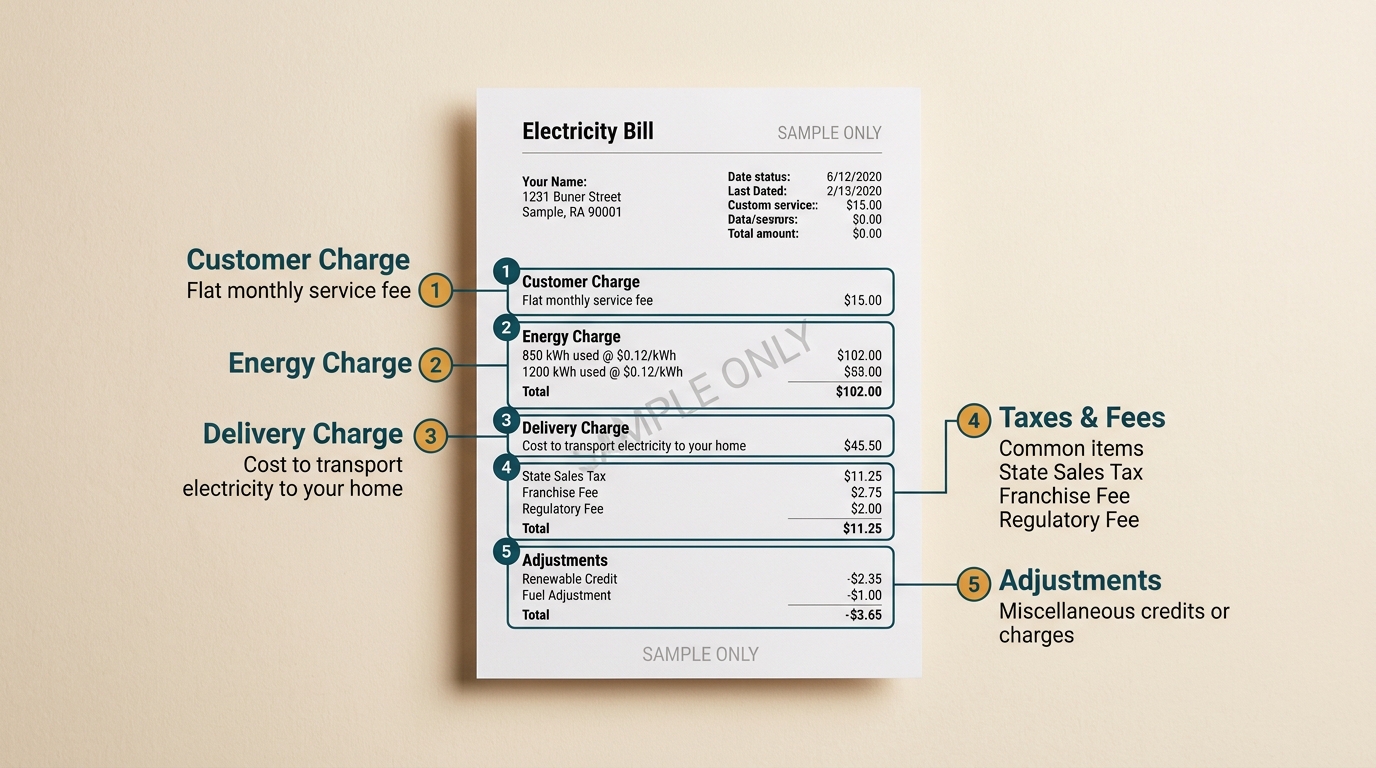
Anatomy of your electricity bill: from meter reading to final charges
Quick Summary: What You’ll Learn
If you’re short on time, here’s the executive summary:
| Section | What It Covers | Why It Matters |
|---|---|---|
| Anatomy of a Bill | The 5 main components of your bill | Understand where your money goes |
| Rate Structures | Flat, tiered, time-of-use | Your rate structure affects your strategy |
| Usage Calculation | How to convert kWh to dollars | Know your actual cost per appliance |
| Red Flags | Signs of billing errors | Catch overcharges before you pay |
| Landlord Issues | When to escalate | Know your rights as a renter |
| Savings Strategy | Using your bill to find savings | Turn data into action |
Bottom line: Reading your bill correctly is the first step to lowering it.
Now let’s break it down.
Chapter 1: The Anatomy of an Apartment Electricity Bill
Every electricity bill — whether from a utility company or a submetering service in your apartment — contains five main components. Understanding each one is essential.
1. Customer Charge (or Service Charge)
What it is: A fixed monthly fee for being connected to the grid. This charge applies even if you use zero electricity.
Typical range: $5–$15 per month for apartments.
Why it matters: You cannot avoid this charge, but you should verify it’s consistent month-to-month. If it suddenly increases without explanation, contact your utility.
2. Energy Charge (or Usage Charge)
What it is: The cost of the actual electricity you consumed, measured in kilowatt-hours (kWh).
Typical range: $0.10–$0.35 per kWh depending on your state.
Why it matters: This is the largest and most variable part of your bill. It’s also the part you have the most control over.
💡 Key insight: If your energy charge is high, your focus should be on reducing consumption — not on arguing with your utility.
3. Delivery Charge (or Transmission Charge)
What it is: The cost of delivering electricity from the power plant to your apartment.
Typical range: $0.03–$0.08 per kWh.
Why it matters: In some states, delivery and supply are bundled. In others (like Texas and Pennsylvania), they’re separate. If your bill shows both, you may be able to shop for a cheaper supplier.
4. Taxes and Regulatory Fees
What it is: State and local taxes, plus fees that fund public utility programs.
Typical range: 5–15% of your total bill.
Why it matters: These are non-negotiable, but they’re a good sanity check. If taxes suddenly jump, your usage probably jumped too.
5. Adjustments and Credits
What it is: One-time charges or credits, such as:
- Budget billing adjustments
- Late payment fees
- Weather-related adjustments
- Low-income assistance credits
Why it matters: These can distort your bill. Always check if a sudden increase is due to a one-time adjustment rather than higher usage.
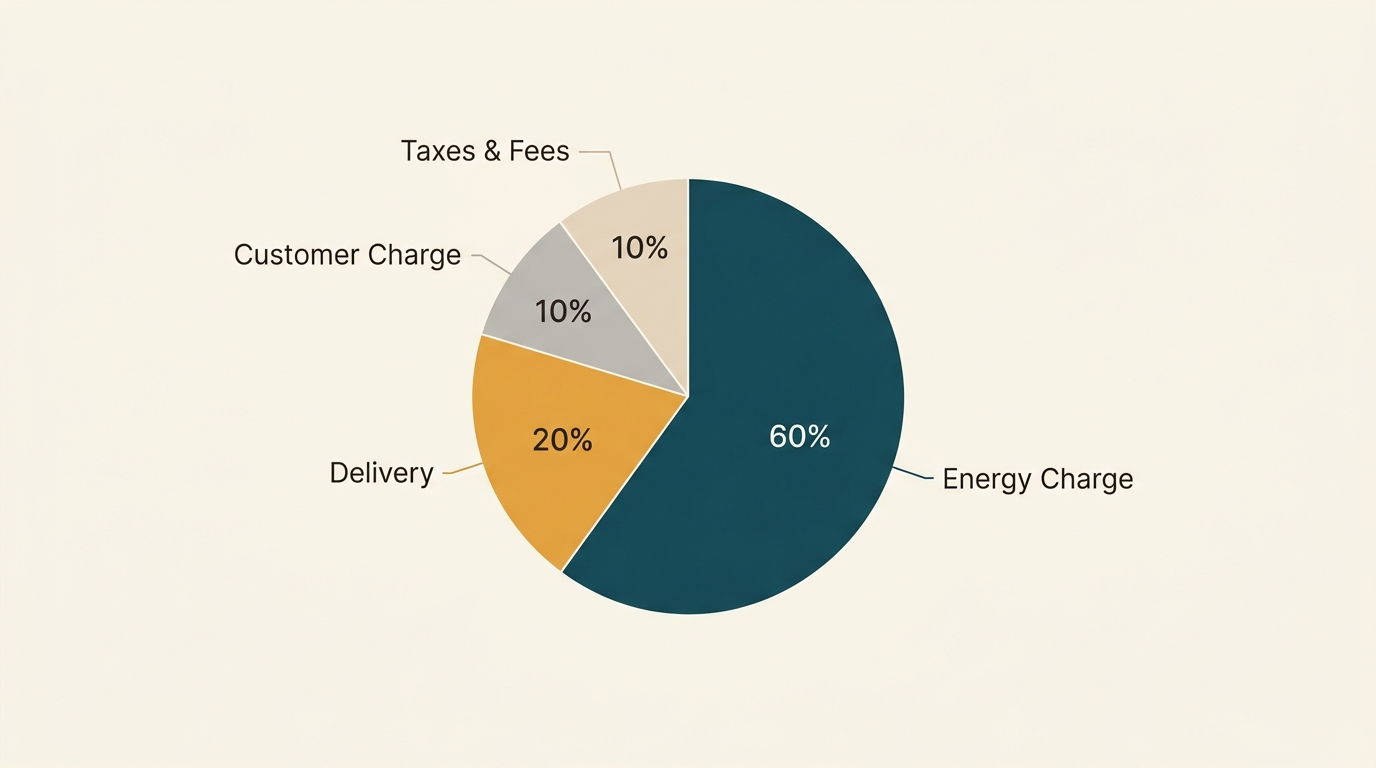
Every charge on your bill, explained in plain English
Chapter 2: Understanding Your Rate Structure
Not all electricity rates are created equal. Your rate structure determines how you’re charged — and it should determine your savings strategy.
Type 1: Flat Rate
How it works: You pay the same rate per kWh regardless of when or how much you use.
Common in: Most apartments in the Midwest and South.
Strategy: Focus on total consumption reduction. Time of use doesn’t matter.
Type 2: Tiered Rate
How it works: The more you use, the higher the rate per kWh. Typically 2–3 tiers.
Example:
- Tier 1: First 500 kWh → $0.12/kWh
- Tier 2: 501–1,000 kWh → $0.18/kWh
- Tier 3: 1,001+ kWh → $0.25/kWh
Common in: California, parts of the Northeast.
Strategy: Stay in Tier 1. The marginal cost of every extra kWh is much higher. Eliminating vampire power (which we cover in our Vampire Power in Rentals guide) becomes even more valuable.
Type 3: Time-of-Use (TOU) Rate
How it works: Electricity costs more during peak hours (typically 4 PM – 9 PM) and less during off-peak hours.
Example:
- Off-peak (before 4 PM): $0.10/kWh
- Peak (4 PM – 9 PM): $0.35/kWh
Common in: California, Arizona, Texas (optional plans).
Strategy: Shift high-consumption activities (laundry, dishwasher, EV charging) to off-peak hours. A programmable smart plug can help automate this.
Type 4: Submetered Billing (Common in Apartments)
How it works: Your apartment has its own meter, but billing is handled by a third-party submetering company rather than the utility directly.
Why it matters: Submetering companies sometimes add administrative fees that can inflate your bill. Always verify the base rate they’re charging matches your local utility rate.
⚠️ Renter warning: If your apartment uses submetering, your bill may include fees that wouldn’t appear on a standard utility bill. Read the fine print.
Chapter 3: How to Calculate Your Daily Usage
This is where most renters get lost. Let’s demystify it.
Step 1: Find Your Total kWh for the Month
Look for “Total Usage” or “kWh Used” on your bill. Example: 750 kWh.
Step 2: Divide by Days in the Billing Cycle
Most billing cycles are 28–32 days. Example:
750 kWh ÷ 30 days = 25 kWh per day
Step 3: Convert to Daily Cost
Using your average rate (say $0.15/kWh):
25 kWh × $0.15 = $3.75 per day
That’s $3.75 per day just to power your apartment. Over a year, that’s $1,369 — and that’s before factoring in seasonal spikes.
Step 4: Identify Your Biggest Loads
Now you know your daily average. The next step is identifying which devices are responsible.
This is where an energy meter like the P3 P4400 Kill A Watt becomes essential. Plug it into your wall, plug an appliance into it, and let it run for 24 hours. You’ll see exactly how much that appliance costs.
For a complete tutorial on using a Kill A Watt meter, see our guide: How to Use a Kill A Watt Meter: The Renter’s Guide to Finding Energy Hogs.
P3 P4400 Kill A Watt Electricity Usage Monitor 🛒 Check Kill A Watt Price on AmazonChapter 4: Red Flags to Watch For
Your bill arrived. Something looks off. Here’s how to spot common errors.
🚩 Red Flag #1: Unexplained Usage Spike
What it looks like: Your kWh usage jumped 30%+ without any lifestyle change.
Possible causes:
- A faulty appliance running 24/7
- A neighbor’s electricity being routed through your meter (rare but possible)
- Seasonal change (heating/AC usage)
What to do: Compare the same month from the previous year. If it’s still abnormally high, request a meter reading verification from your utility.
🚩 Red Flag #2: Estimated Bills Instead of Actual Readings
What it looks like: Your bill says “Estimated Reading” instead of “Actual Reading.”
Why it matters: Estimated bills are based on historical usage and can be wildly inaccurate. You may be overpaying now and underpaying later (or vice versa).
What to do: Request an actual meter reading. In many states, this is your legal right.
🚩 Red Flag #3: Fees You Don’t Recognize
What it looks like: Line items like “Submetering Admin Fee,” “Convenience Fee,” or “Processing Charge.”
Why it matters: Some of these fees are legitimate; others are not. Submetering companies are regulated differently by state.
What to do: Look up your state’s Public Utility Commission (PUC) rules on submetering. If a fee seems excessive, file a complaint.
🚩 Red Flag #4: Rate Change Without Notice
What it looks like: Your $0.12/kWh rate suddenly becomes $0.18/kWh.
Why it matters: Rate changes require advance notice in most states. If you didn’t receive notice, this may be a billing error.
What to do: Contact your utility or submetering company in writing and request an explanation.
🚩 Red Flag #5: Zero Usage for a Month
What it looks like: Your bill shows 0 kWh used, but your total is still high.
Why it matters: This usually means you’re being charged only fixed fees — but if it happens during a month when you were home, it may indicate a meter malfunction that will be corrected later (causing a spike).
What to do: Document everything. Take photos of your meter on the first and last day of the month.
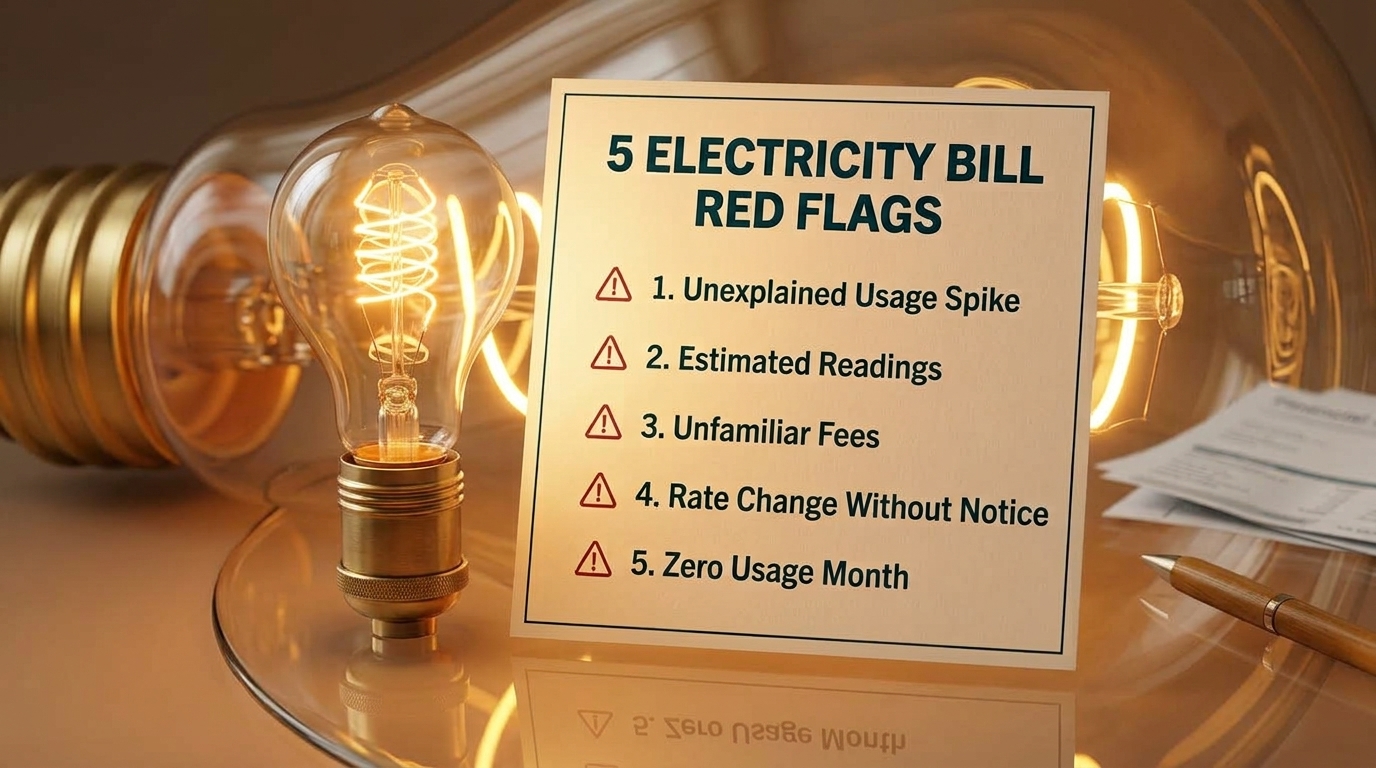
Red flags on your bill: what to question before you pay
Chapter 5: When to Contact Your Landlord
As a renter, you have specific rights — and specific limitations. Here’s when to escalate.
Situation 1: Utilities Included in Rent
If your lease says “utilities included,” your landlord pays the electricity bill. You have limited leverage to reduce costs, but you can still:
- Report malfunctioning appliances (they’re wasting the landlord’s money too)
- Request energy-efficient upgrades at lease renewal
- Document excessive usage caused by landlord-owned appliances
Situation 2: Individually Metered (You Pay the Utility)
If you have your own meter and pay the utility directly, you have full control. Contact the utility — not the landlord — for billing issues.
Situation 3: Submetered (Landlord or Third Party Bills You)
This is the gray area. Your landlord (or their submetering company) bills you. Here’s when to escalate:
- Billing error: Contact the submetering company in writing first.
- No response: Escalate to your landlord.
- Still no response: File a complaint with your state’s PUC.
- Pattern of overcharges: Consult a tenant rights organization.
💡 Pro tip: Always communicate in writing (email, not phone). Keep copies of everything. If you need to escalate, you’ll have documentation.
Chapter 6: Using Your Bill to Find Savings
Now that you understand your bill, here’s how to turn that knowledge into action.
Strategy 1: Target Your Biggest Loads
If your energy charge is 60% of your bill, focus there. Use a Kill A Watt meter to identify the top 3 energy consumers in your apartment. Common culprits:
- Old refrigerators ($50–$100/year)
- Set-top boxes ($130/year — see our Vampire Power guide)
- Gaming consoles ($30–$50/year)
- Space heaters ($100–$200/year in winter)
Strategy 2: Shift Usage if You’re on TOU
If you’re on a Time-of-Use rate, shift high-consumption activities to off-peak hours. Even a simple change like running the dishwasher at 10 PM instead of 6 PM can save $5–$15/month.
Strategy 3: Replace Inefficient Bulbs
If your bill shows high lighting usage (or you still have incandescent bulbs), swapping to LEDs is the fastest, most portable win for renters.
Philips LED 75W A19 Selectable White (5-CCT: 2700K–5000K), 4-PackFor a full room-by-room plan, see our Best LED Bulbs for Renters guide.
Strategy 4: Automate with Smart Plugs
Once you know which devices are the biggest offenders, smart plugs can automate the shutdown. Schedule your entertainment center to power off between 1 AM and 6 AM. Schedule your coffee maker to shut off after 30 minutes.
Kasa Smart Plug KP405 (Energy Monitoring)For detailed recommendations, see our Best Smart Plugs for Apartments guide.
Strategy 5: Verify Your Rate
If you’re on a flat rate, verify it matches your utility’s published rate. If you’re on submetering, verify the base rate. Rate discrepancies are more common than you’d think.
Strategy 6: Check for Assistance Programs
Many states offer Low-Income Home Energy Assistance Program (LIHEAP) benefits for renters, even if utilities are included in rent. Check your state’s program.
How Much Can Renters Realistically Save?
The savings depend on three factors:
- Your current usage (higher usage = more room to cut)
- Your rate structure (TOU offers more strategic opportunities)
- Your willingness to change habits
Based on data from the DOE and NRDC:
| Action | Annual Savings |
|---|---|
| Eliminating vampire power | $100–$400 |
| Switching to LED bulbs | $50–$100 |
| Shifting TOU usage | $60–$180 |
| Optimizing thermostat | $100–$200 |
| Total potential | $300–$900 |
Realistically, most renters can save $200–$500 per year by applying the strategies in this guide.
Conclusion
Your electricity bill is not a mysterious document. It’s a data report about your energy consumption — and once you know how to read it, you can act on it.
Your action plan:
- Locate your last 3 bills. Compare usage patterns.
- Identify your rate structure. Flat, tiered, or TOU?
- Calculate your daily kWh cost. Use the formula in Chapter 3.
- Spot red flags. Check for estimated readings, unexplained spikes, or unfamiliar fees.
- Measure your biggest loads. Use a Kill A Watt meter to find your top energy consumers.
- Take action. Eliminate vampire power, switch to LED, automate with smart plugs.
🛒 Start Measuring — Check Kill A Watt on AmazonNext step: If you haven’t already, read our Vampire Power in Rentals guide to learn the 7 hidden devices draining your bill right now — and our How to Use a Kill A Watt Meter guide to turn your bill data into a personalized savings plan.
Frequently Asked Questions
How do I read my apartment electricity bill if utilities are included in rent?
If utilities are included, you typically won’t receive a bill. However, you can request a copy of the building’s utility bill from your landlord for transparency. Some states require landlords to disclose utility costs when utilities are included in rent.
What is a “submetering fee” and is it legal?
Submetering fees are charged by third-party companies that install individual meters in apartments. Legality varies by state. In most states, submetering is legal but regulated. Check with your state’s Public Utility Commission (PUC) for specific rules.
Can my landlord charge me more for electricity than the utility charges?
In most states, landlords cannot mark up the cost of electricity beyond the actual utility rate. However, they may add legitimate administrative fees. If you suspect overcharging, request an itemized bill and compare it to your utility’s published rates.
What should I do if I find a billing error?
Contact the billing party (utility or submetering company) in writing. Explain the error and request a correction. If they don’t respond within 30 days, escalate to your state’s PUC or a tenant rights organization.
How often should I review my electricity bill?
Review it every month. Look for:
- Unexplained usage changes
- Rate changes
- New fees
- Estimated vs. actual readings
A 5-minute review each month can save you hundreds over a year.
About This Article
WattDweller is a reader-supported publication dedicated to helping renters reduce energy costs without permanent modifications.
For information about how we develop and review content, see our Editorial Policy.
Sources: Energy information cited in this article comes from the sources linked throughout the article, including the U.S. Energy Information Administration (EIA), the U.S. Department of Energy (DOE), and the Natural Resources Defense Council (NRDC).
Last Updated: September 24, 2026
Related reading
- Vampire Power in Rentals: 7 Hidden Devices Quietly Inflating Your Electricity Bill
- How to Use a Kill A Watt Meter: The Renter’s Guide to Finding Energy Hogs
- Best LED Bulbs for Renters: Brighten Your Apartment Without Rewiring
- Portable AC vs Window Unit: A Renter’s Guide
- Best Smart Plugs for Apartments: Energy Monitoring, Scheduling & No Wiring