Portable AC vs Window Unit: Which Is Better for Renters? (2026 Guide)
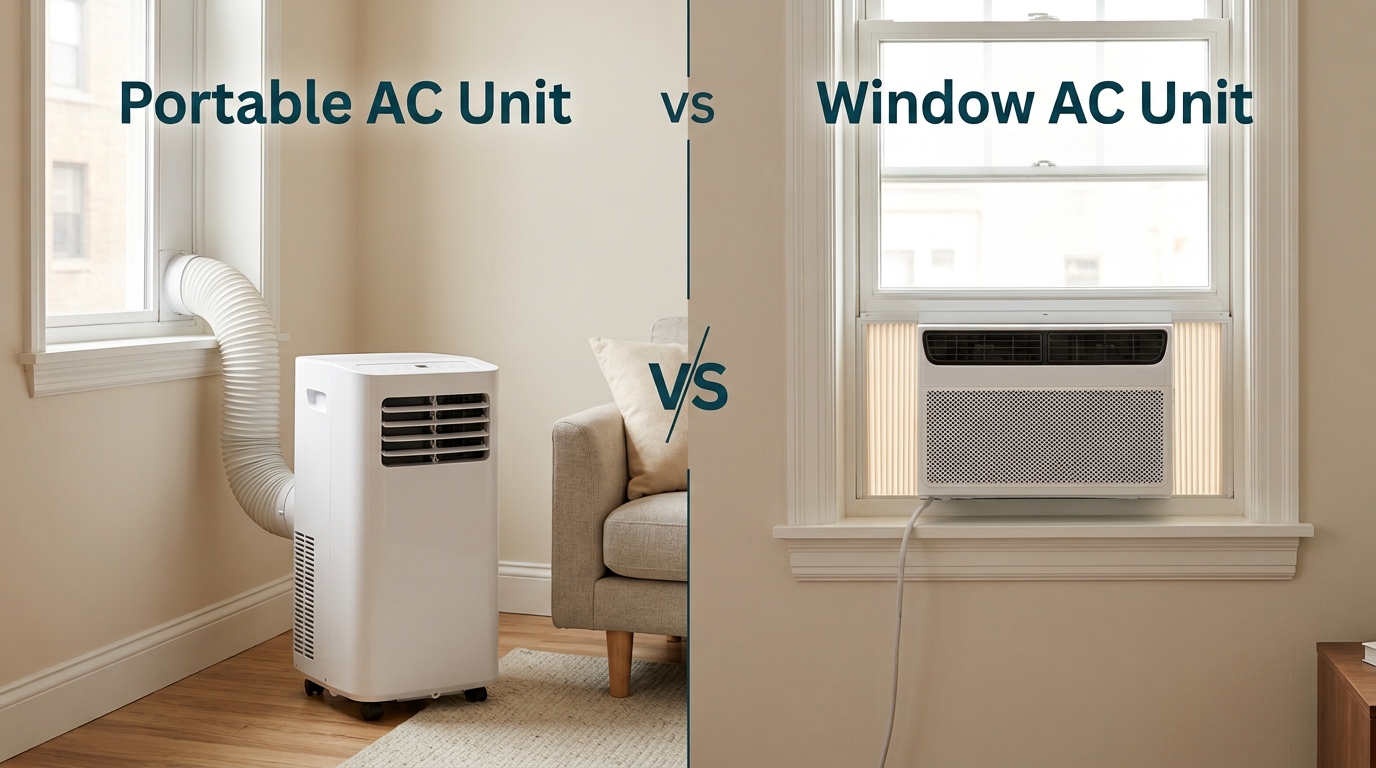
Portable AC vs window unit: which one works for renters?
By WattDweller Editorial Team · Updated September 24, 2026
Summer is coming. Your apartment has no central air. And you’re about to make a decision that will affect your comfort — and your electricity bill — for the next 3–4 months.
Portable AC or window unit?
It’s the most common cooling dilemma for renters. Both options work without major installation. Both can be removed when you move. Both are available at every major retailer for $300–$700.
But here’s what most buying guides won’t tell you: they are not equal. One cools faster, uses less electricity, and costs less to run. The other is more flexible, works in awkward windows, and won’t violate a strict lease.
According to Business Insider’s testing, a portable AC uses 0.88 kWh per hour on average, while a window unit uses only 0.43 kWh per hour — roughly half the energy for the same cooling output. Over a full summer season, that difference adds up to about $52 more to run a portable unit.
But energy efficiency isn’t the only factor. Your window type, your lease terms, and your cooling needs all matter.
In this guide, we’ll compare portable AC vs window unit across every dimension that matters for renters: cooling performance, energy use, cost, installation, lease risk, and which specific situations favor each option.
🛒 Check Midea U Window AC on Amazon💡 Short on time? Our top pick for most renters is the Midea U Inverter Window AC — it uses an inverter compressor, runs as low as 42 dB, and fits standard double-hung windows without blocking the view.
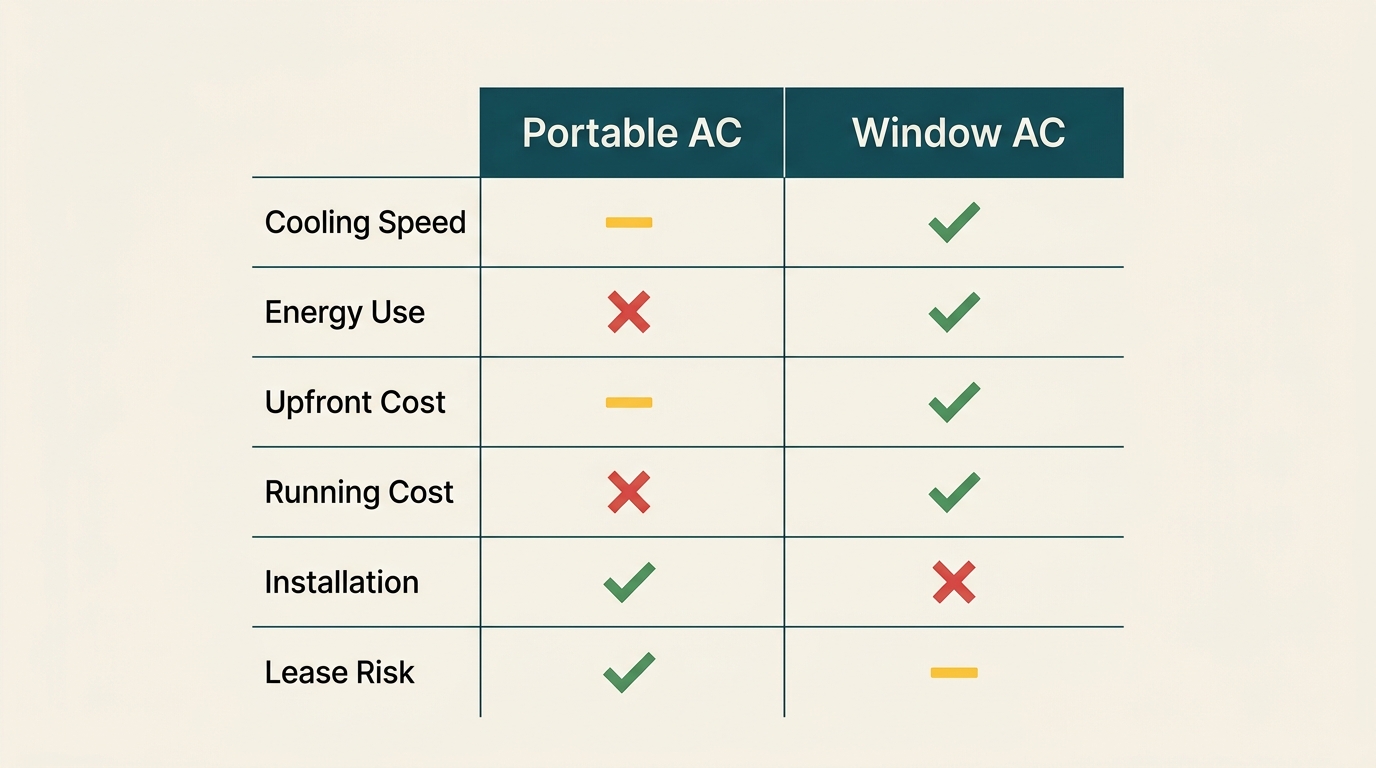
Portable vs window AC: cost, efficiency, install, and portability
Quick Summary: The Renter’s AC Cheat Sheet
If you’re short on time, here’s the bottom line:
| Factor | Portable AC | Window AC |
|---|---|---|
| Cooling Speed | Slower (fights its own heat) | Faster (vents heat directly outside) |
| Energy Use | ~0.88 kWh/hour | ~0.43 kWh/hour |
| Upfront Cost | $300–$700 | $150–$500 |
| Seasonal Running Cost | ~$52 more than window | Lower |
| Installation | Tool-free, hose to window | Requires secure window mounting |
| Lease Risk | Very low (no permanent changes) | Moderate (window must support it) |
| Best For | Awkward windows, strict leases, multi-room use | Standard windows, long-term cooling, energy savings |
Bottom line: If you have a standard window and your lease allows it, a window unit is the better choice for efficiency and performance. If your window is awkward, your lease is strict, or you need flexibility, a portable AC is the safer renter-friendly option.
🛒 Check Midea U Window AC on Amazon🏆 Top pick for most renters: Midea U Inverter Window AC — the quietest, most efficient window unit we’ve found for standard apartment windows.
Now let’s break it down.
Chapter 1: How Each Type Actually Works (And Why It Matters)
Understanding why these two AC types perform differently is the key to choosing wisely. The physics are simple, but the implications are significant.
How a Window AC Works
A window AC is a single, sealed unit that sits in your window frame. The compressor and all heat-producing mechanical parts are outside the room, venting heat directly outdoors.
Why this matters: The unit never fights its own heat. Cool air blows into the room, hot air goes outside, and the process is as efficient as physics allows for a single-room cooling solution.
Result: Faster cooling, better humidity removal, lower energy consumption.
How a Portable AC Works
A portable AC sits inside your room. It blows cold air from the front, but the back of the unit and the exhaust hose get very warm.
Why this matters: The unit creates a “radiator effect” — it’s simultaneously cooling your room and heating it back up. The exhaust hose also leaks some heat back into the space, especially if it’s not well-sealed.
Worse, as the unit pushes hot air out through the hose, it creates negative pressure — which pulls warm air back in through gaps under doors and around windows.
Result: Slower cooling, higher energy consumption, and a unit that has to work harder to achieve the same result.
The Efficiency Gap in Numbers
| Metric | Window AC | Portable AC | Difference |
|---|---|---|---|
| Energy use per hour | 0.43 kWh | 0.88 kWh | 2x more for portable |
| Seasonal running cost (est.) | Baseline | +$52 | Portable costs more |
| Cooling speed | Fast | Slower | Window wins |
| Humidity removal | Better | Adequate | Window wins |
According to HVAC experts, “window units typically cool a room faster, remove humidity more effectively, and consume less electricity than portable units.”
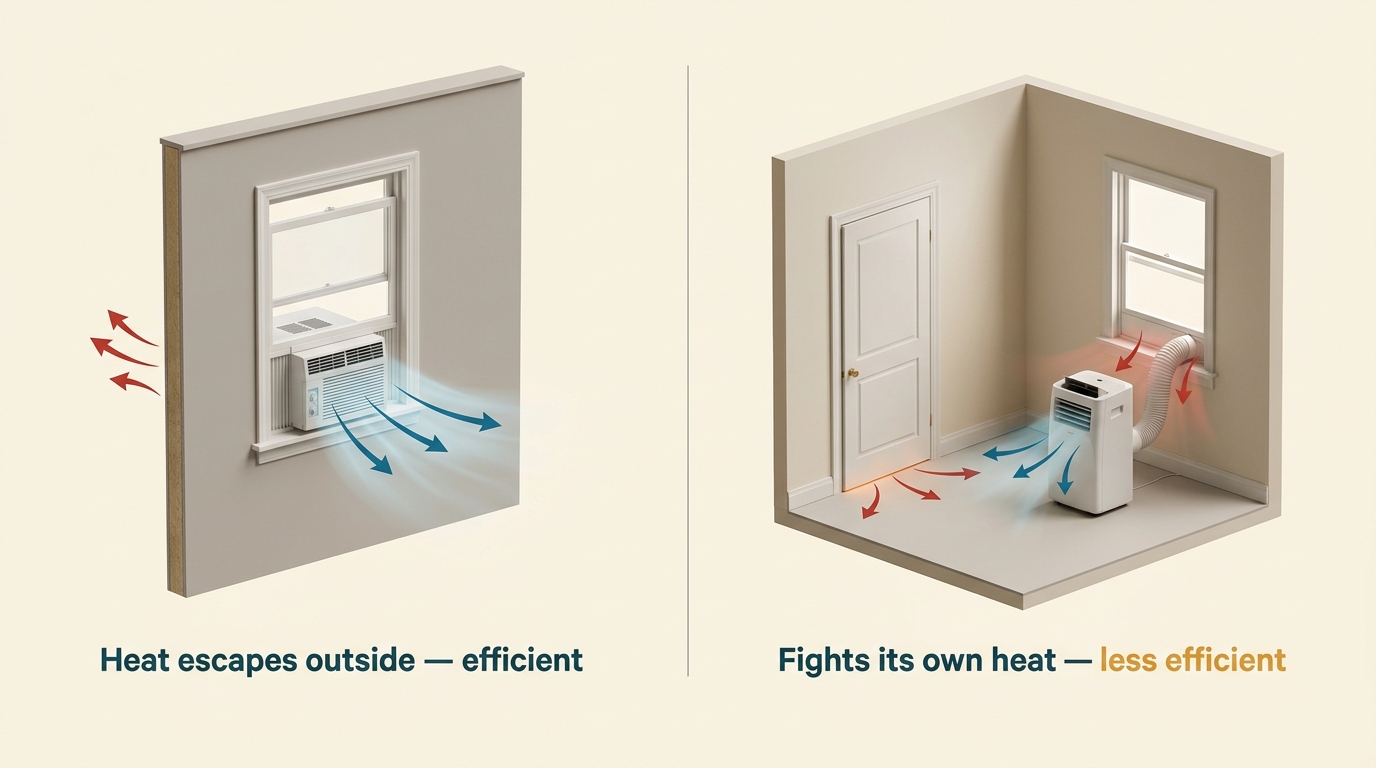
The physics behind portable vs window AC cooling
Chapter 2: Cost Analysis — Upfront vs. Running Costs
Most renters focus on the sticker price when buying an AC. But the real cost of ownership is upfront price + running cost over the season. And here’s the surprise: the cheaper option upfront is often the cheaper option long-term.
Upfront Cost Comparison
| Unit Size | Portable AC | Window AC |
|---|---|---|
| Small (5,000–6,000 BTU, ~150 sq ft) | $300–$400 | $150–$250 |
| Medium (8,000–10,000 BTU, ~300 sq ft) | $400–$550 | $250–$400 |
| Large (12,000–14,000 BTU, ~500 sq ft) | $500–$700 | $400–$600 |
Observation: Window units are consistently $100–$200 cheaper for equivalent cooling capacity. The price gap narrows as you go larger, but never disappears.
Running Cost Comparison
This is where the efficiency gap really shows. Let’s calculate the running cost for a full summer season (assume 4 months of use, 8 hours per day).
Assumptions:
- Cooling season: 120 days
- Daily use: 8 hours
- Electricity rate: $0.16/kWh (U.S. average)
Window AC (10,000 BTU, 0.43 kWh/hour): 0.43 kWh × 8 hours × 120 days = 412.8 kWh per season 412.8 kWh × $0.16 = $66.05 per season
Portable AC (10,000 BTU, 0.88 kWh/hour): 0.88 kWh × 8 hours × 120 days = 844.8 kWh per season 844.8 kWh × $0.16 = $135.17 per season
Seasonal running cost difference: $69.12.
That’s more than the upfront price difference. Over a 3-year ownership period, the portable AC will have cost you $207 more in electricity alone.
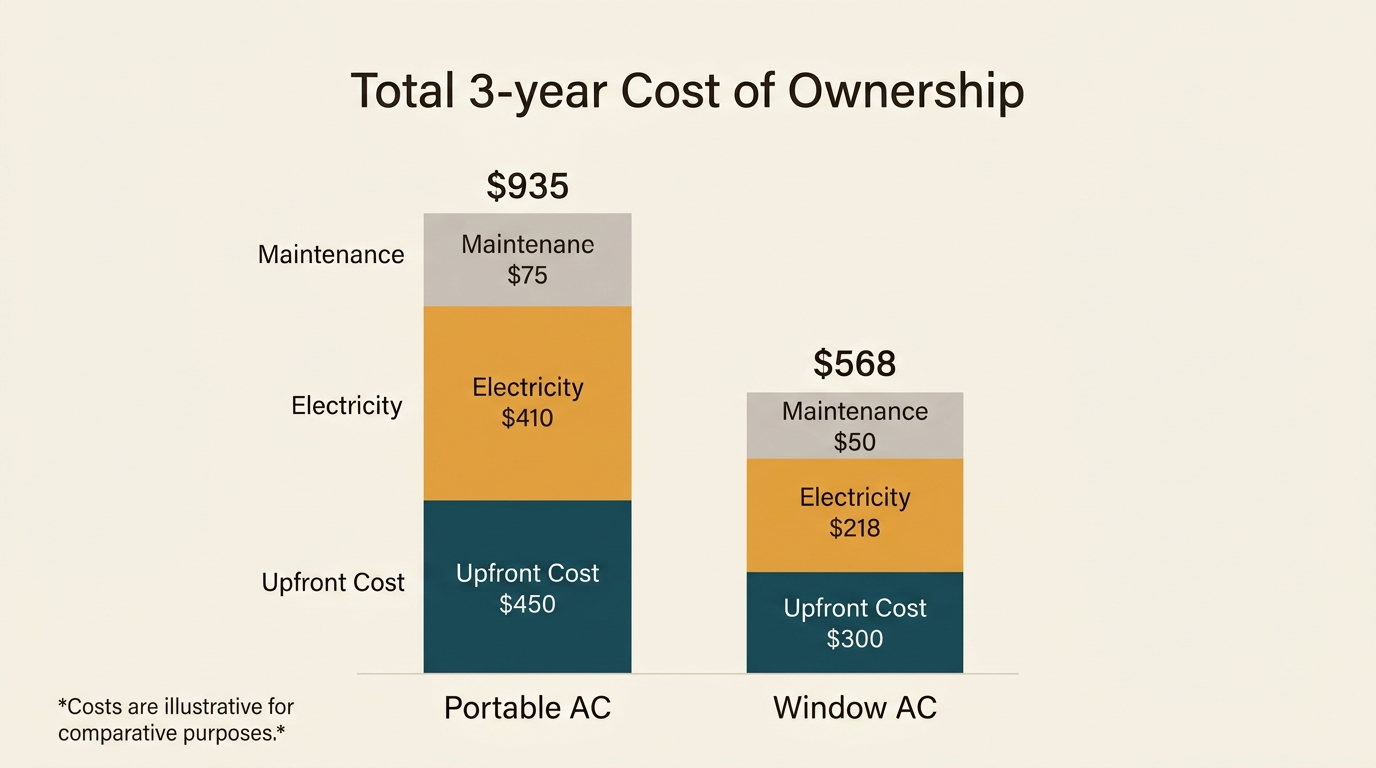
Total Cost of Ownership (3 Years)
| Cost Component | Portable AC | Window AC |
|---|---|---|
| Upfront (10,000 BTU) | $500 | $350 |
| Electricity (3 seasons) | $405 | $198 |
| Maintenance / filters | $30 | $20 |
| 3-Year Total | $935 | $568 |
The window AC saves you roughly $367 over 3 years.
But Wait — There Are Exceptions
The running cost math assumes both units are cooling the same space at the same efficiency. Real-world factors change this:
Factors that favor portable AC:
- You only cool one room. A portable AC used in a single bedroom can be more efficient than a window unit cooling a larger space.
- You move frequently. Portability has value if you relocate every year.
- Your window can’t support a window unit. In that case, portable is the only option.
Factors that favor window AC:
- You cool a larger space. The efficiency gap grows with unit size.
- You stay in the same apartment for 2+ years. Long-term efficiency savings outweigh portability.
- Your lease allows window units. No installation risk means no compromise.
💡 Renter tip: If you’re planning to stay in your apartment for more than one summer, the window unit almost always wins on total cost. If you’re likely to move within a year, the portability of a portable AC may justify the higher running cost.
Monthly operating cost: portable AC vs window AC
The Hidden Cost of Portable AC: The “Second Unit” Trap
Here’s a pattern that surprises many renters: portable ACs are often underpowered for the space they’re advertised to cool. A “10,000 BTU” portable unit might struggle to cool a 300 sq ft room that a 10,000 BTU window unit handles easily.
The reason: portable AC BTU ratings are measured under ideal conditions that rarely match real-world use. Once you factor in heat leakage from the exhaust hose and negative pressure, the effective cooling capacity drops by 20–30%.
What this means: Renters often end up buying a larger portable AC (12,000–14,000 BTU) than they would a window unit — which pushes the upfront cost even higher.
Chapter 3: Installation & Lease Considerations
For renters, installation and lease compliance are often more important than efficiency. Here’s what you need to know before you buy either unit.
Window AC Installation
What’s required:
- A standard double-hung or sliding window that opens at least 15–16 inches vertically
- A secure mounting system (most units come with a bracket or accordion side panels)
- Ideally, access to an electrical outlet near the window
- Ideally, a window sill that can support 40–80 lbs of weight
Installation time: 30–60 minutes for a first-timer.
Tools required: Screwdriver, possibly a drill for the security bracket, a level.
Lease considerations:
| Lease Scenario | Window AC Acceptable? |
|---|---|
| Lease explicitly allows window AC | ✅ Yes |
| Lease is silent on window AC | ⚠️ Gray area — ask first |
| Lease prohibits “installations” or “attachments” | ❌ Likely prohibited |
| Lease requires professional installation | ⚠️ Extra cost, but doable |
| You’re on the ground floor or easy-access window | ⚠️ Security risk — use a bracket |
Renter warning: Window AC units are a common cause of window damage (scratches, sill cracks) and a common source of lease disputes. Always:
- Photograph the window before installation
- Use a proper mounting bracket (not just the included accordion panels)
- Add weather stripping or foam to seal gaps
- Remove the unit before move-out and inspect the window
Portable AC Installation
What’s required:
- A window or sliding door to vent the exhaust hose
- The included window kit (usually a plastic panel with a hole for the hose)
- An electrical outlet near the unit
- Floor space for the unit itself (typically 12" × 12" or larger)
Installation time: 15–30 minutes.
Tools required: None (the kit includes everything).
Lease considerations:
| Lease Scenario | Portable AC Acceptable? |
|---|---|
| Lease allows window AC | ✅ Yes (portable is less invasive) |
| Lease is silent on window AC | ✅ Generally fine — no drilling required |
| Lease prohibits “installations” | ✅ Generally fine — it’s not an installation |
| Lease prohibits “attachments to windows” | ⚠️ Depends on how the window kit is mounted |
| You’re in a high-rise with sealed windows | ❌ Check if windows can be opened |
Renter advantage: Portable ACs are generally lease-safe because:
- No drilling or permanent mounting
- The window kit is removable and leaves no trace
- You can restore the window to its original state in 5 minutes
Renter caution: Some HOAs and apartment buildings (especially high-rises) prohibit any visible modification to windows or facades, including window kits. Check your building’s rules before buying.
⚠️ Renter warning: Even “portable” ACs have lease implications if your building has rules about window appearance. Read your lease, and if in doubt, ask your landlord in writing before purchasing.
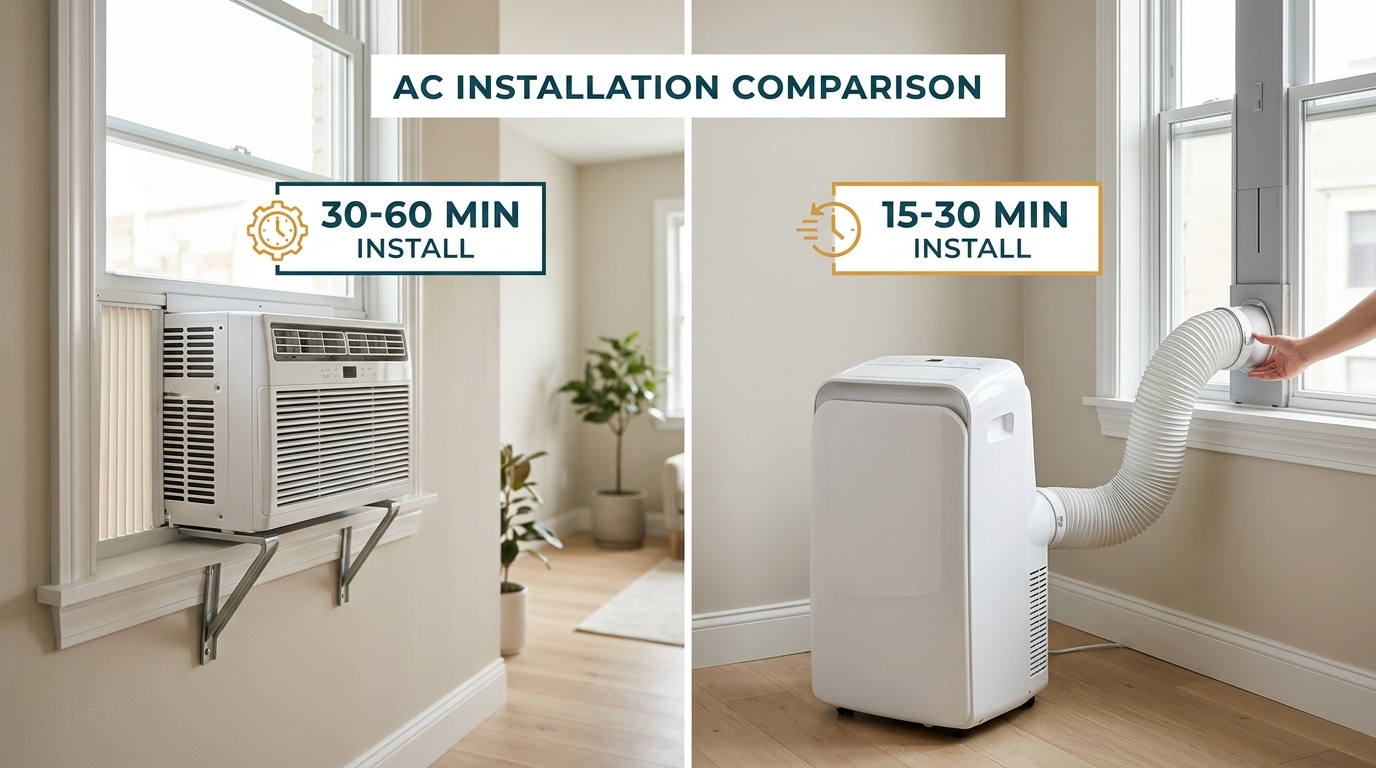
Installation: portable AC wins for renters with strict leases
Window Type Compatibility
Not all windows work with all AC units. Here’s the compatibility matrix:
| Window Type | Window AC | Portable AC |
|---|---|---|
| Double-hung (standard) | ✅ Yes | ✅ Yes |
| Sliding window (horizontal) | ✅ Yes (with kit) | ✅ Yes |
| Casement (crank-out) | ❌ No | ✅ Yes (with adapter) |
| Awning (top-hinged) | ❌ No | ✅ Yes (with adapter) |
| Bay window | ⚠️ Sometimes | ✅ Yes |
| Sealed high-rise window | ❌ No | ❌ No |
Takeaway: If you have a casement, awning, or sealed window, your only option is a portable AC with an appropriate adapter. This is the single biggest reason renters choose portable over window units.
Security Considerations
Window AC: A window-mounted unit can be a security risk on ground floors or easy-access windows. Use a security bracket and, ideally, a window lock that works with the unit installed.
Portable AC: The window kit can also be a security risk if not properly installed. Look for kits with a locking mechanism or use a window bar.
Renter tip: If security is a concern, install the AC in a window that’s not easily accessible from outside (or use a portable unit in a room with a less accessible window).
Chapter 4: Performance Comparison — Beyond the Specs
Efficiency and cost are important, but they’re not the whole story. How does each unit actually feel to live with? Here’s what the spec sheets don’t tell you.
Cooling Speed & Power
Window AC: Cools a room in 10–20 minutes for a standard bedroom. The compressor is powerful, the airflow is direct, and there’s no heat leakage.
Portable AC: Cools a room in 20–40 minutes for the same space. The unit has to overcome its own heat output, and negative pressure pulls warm air back in. Users often report that portable units “never quite catch up” on the hottest days.
Verdict: Window AC wins clearly. If you need fast relief on a 95°F afternoon, the window unit is the right choice.
Noise Levels
| AC Type | Typical Noise Level | Comparable To |
|---|---|---|
| Window AC (modern inverter) | 45–55 dB | Quiet conversation |
| Window AC (standard) | 55–65 dB | Normal conversation |
| Portable AC (modern) | 50–60 dB | Refrigerator hum |
| Portable AC (budget) | 60–70 dB | Vacuum cleaner |
Reality check: Both types are audible. Window units tend to be slightly quieter when installed properly (the compressor is outside). Portable units have the compressor inside the room, so the noise is more noticeable.
Renter tip: If you’re a light sleeper or work from home on calls, look for units with inverter compressors (both window and portable versions exist). These are significantly quieter and more efficient than standard compressors.
Humidity Removal
Window AC: Excellent. The unit pulls humid air from the room, condenses it, and drains it outside (or into a drip tray). This is why window AC rooms feel “crisp” rather than “clammy.”
Portable AC: Adequate, but less effective. Some portable units have a “self-evaporative” system that recycles moisture, which can make the room feel more humid. Others require you to manually drain a tank — which is annoying and easy to forget.
Verdict: Window AC wins, especially in humid climates. If you live in the Southeast or Mid-Atlantic, this matters.
Airflow & Distribution
Window AC: Direct, powerful airflow. You can aim the vents to cool a specific area (like your bed or desk). The cool air circulates naturally because the unit is high up (in a window).
Portable AC: Weaker airflow. Most portable units blow cool air at floor level, which means it takes longer to circulate. Some units have oscillating vents, but the effect is limited.
Verdict: Window AC wins for airflow distribution. Portable ACs work best in small, enclosed rooms.
Lifespan & Reliability
| AC Type | Typical Lifespan | Common Issues |
|---|---|---|
| Window AC | 8–12 years | Fan motor failure, refrigerant leak |
| Portable AC | 5–8 years | Hose wear, drainage issues, compressor failure |
Verdict: Window AC wins on longevity. The simpler design (fewer moving parts, no hose) means fewer failure points.
Environmental Impact
Window AC: Uses less energy (lower carbon footprint), contains refrigerant that must be properly disposed of, lasts longer.
Portable AC: Uses more energy (higher carbon footprint during use), also contains refrigerant, shorter lifespan means more frequent replacement.
Verdict: Window AC is more environmentally friendly — both because of lower energy use and longer lifespan.
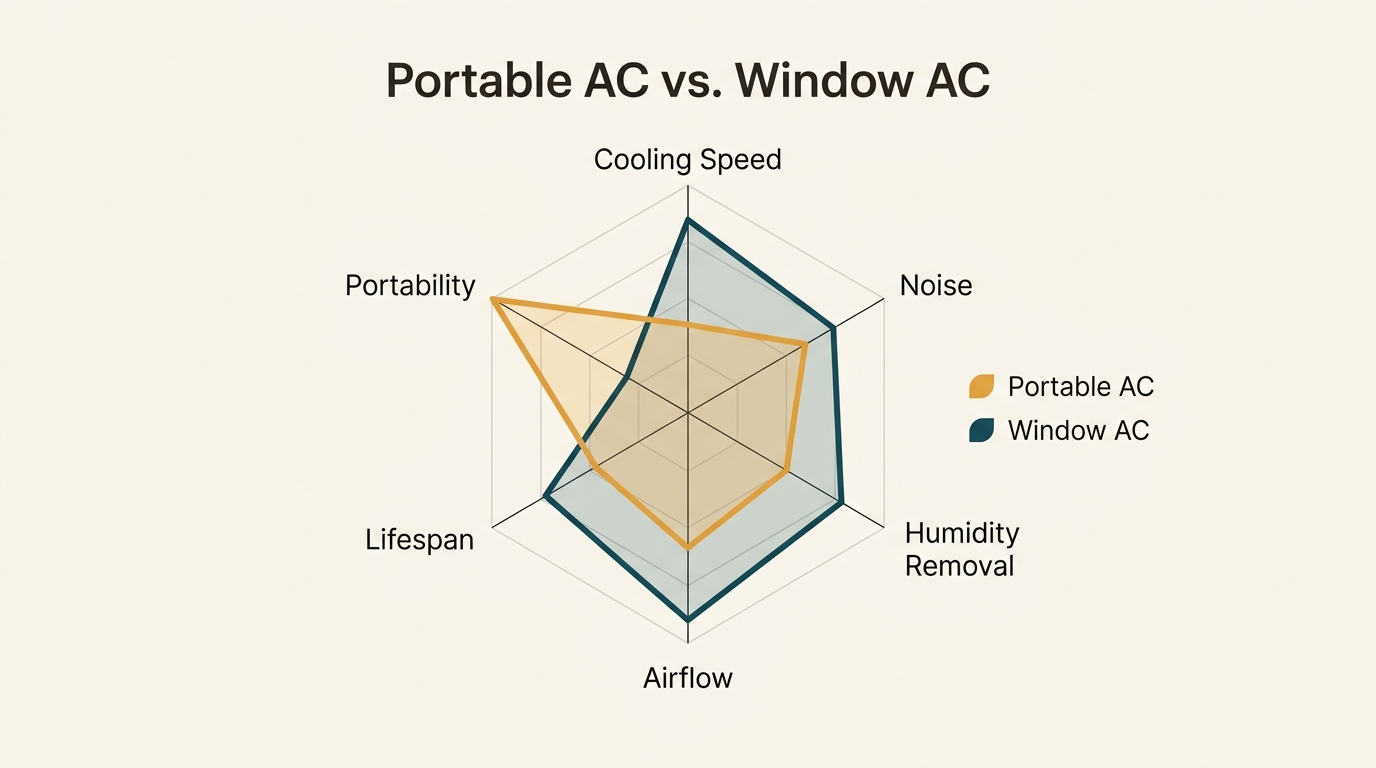
Performance radar: cooling power, noise, efficiency, and portability
Chapter 5: Top Picks — Best Portable AC & Best Window AC for Renters
Now that you understand the trade-offs, here are our recommendations for the best units in each category. We’ve selected these based on renter-specific criteria: easy installation, reasonable cost, energy efficiency, and reliability.
1. Best Window AC Overall: Midea U Inverter Window AC
Why we recommend it:
The Midea U is a game-changer in the window AC category. It uses an inverter compressor that:
- Uses up to 35% less energy than standard window ACs
- Operates at significantly lower noise levels (as low as 42 dB)
- Maintains more consistent temperature (no on/off cycling)
- Allows you to open the window even when installed (the U-shape design lets the window close around it)
Renter-specific advantages:
- Fits standard double-hung windows
- Includes a secure mounting bracket
- Removes easily at move-out
- Energy Star certified
Specs:
- BTU: 8,000–12,000 (multiple sizes available)
- Energy use: ~0.35 kWh/hour (8,000 BTU model)
- Noise: 42–48 dB
- Voltage: 115V (standard outlet)
- Remote: Yes
- Wi-Fi: Yes (app control)
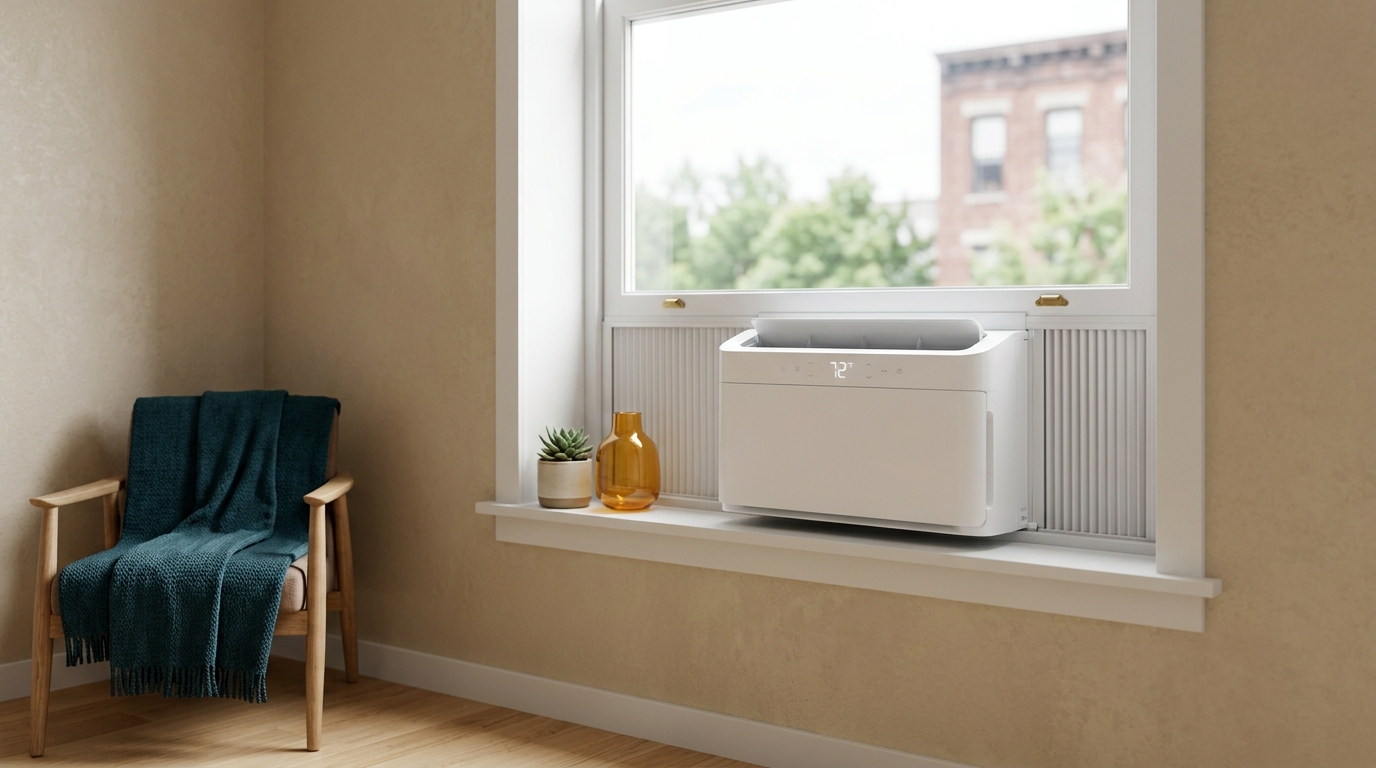
Midea U window AC — quiet, efficient, window-friendly
2. Best Budget Window AC: Frigidaire Window AC
Why we recommend it:
If the Midea U is out of budget or unavailable, the Frigidaire is a solid, reliable alternative. It’s not as efficient as the Midea U, but it’s $100–$150 cheaper and still does the job well.
Renter-specific advantages:
- Standard window installation
- Widely available (Home Depot, Lowe’s, Amazon)
- Reliable brand with good service network
- Multiple BTU sizes for different apartment layouts
Specs:
- BTU: 5,000–12,000
- Energy use: ~0.43 kWh/hour (8,000 BTU model)
- Noise: 50–55 dB
- Voltage: 115V
- Remote: Yes
- Wi-Fi: Optional (some models)
3. Best Portable AC: Midea Duo Portable AC (Inverter, Dual Hose)
Why we recommend it:
The Midea Duo is one of the few portable ACs that actually performs close to its rated BTU. It uses a dual-hose system (most portable ACs use a single hose), which:
- Reduces negative pressure
- Improves cooling efficiency
- Prevents warm air from being pulled back into the room
It also uses an inverter compressor — a rare feature in portable ACs — which makes it significantly quieter and more efficient than single-hose alternatives.
Renter-specific advantages:
- No permanent installation
- Fits casement and awning windows (with adapter)
- Removable window kit
- Casters for easy moving between rooms
- Self-evaporative (minimal draining)
- Inverter compressor: quieter and more energy-efficient
Specs:
- BTU: 14,000 (dual-hose, inverter)
- Energy use: ~0.85 kWh/hour
- Noise: 42–50 dB (quietest in the portable category)
- Voltage: 115V
- Remote: Yes
- Wi-Fi: Yes (app control)
- Window kit: Included
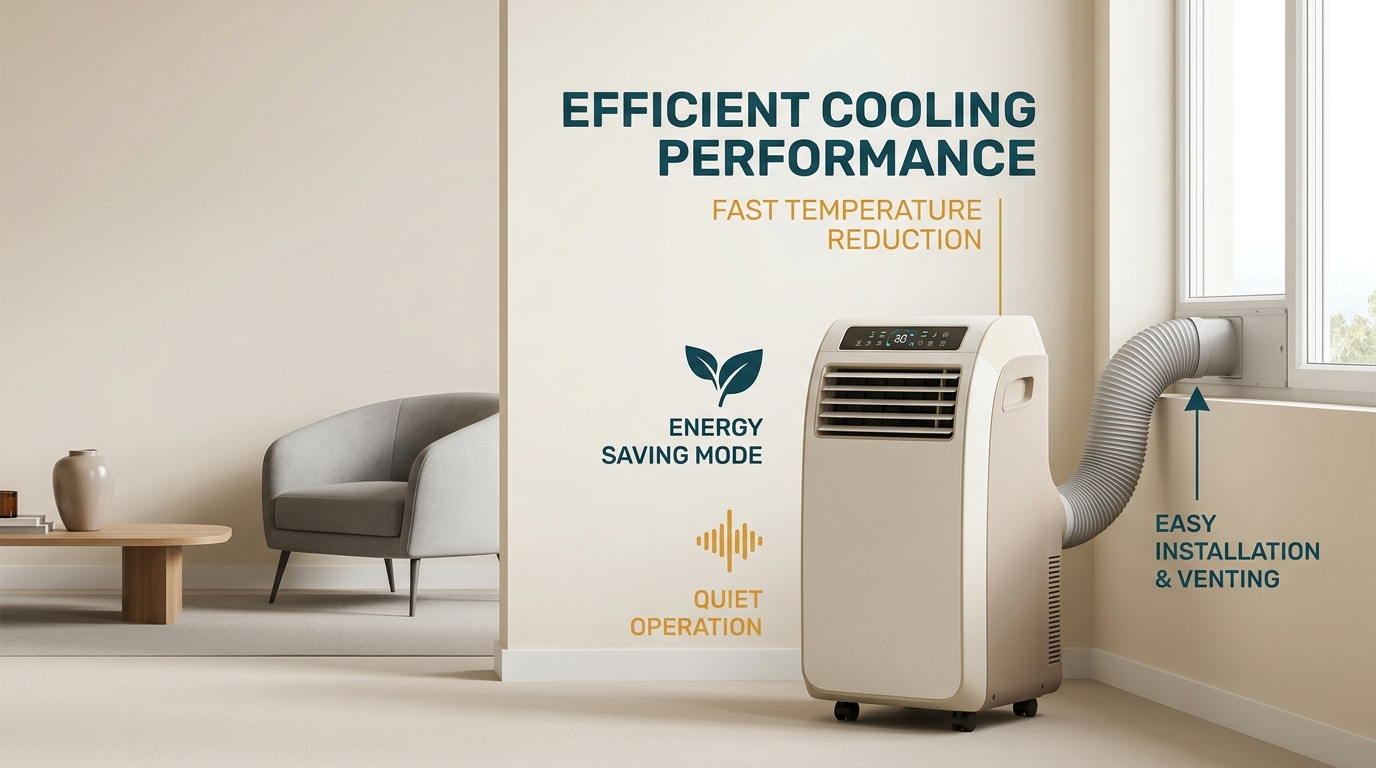
Midea Duo portable AC — dual-hose, inverter, no window drilling required
💡 Renter warning: For portable ACs, always buy 10–20% more BTU than the manufacturer recommends for your room size. The advertised BTU rarely matches real-world performance.
What About Budget Portable ACs?
If the Midea Duo is out of budget, you might be tempted by the $300–$400 single-hose portable units from other brands. Here’s the honest trade-off:
- They work — for small bedrooms and home offices (under 200 sq ft)
- They’re louder — usually 55–65 dB
- They’re less efficient — single-hose units create more negative pressure and lose 20–30% effective cooling capacity
- They usually lack inverter compressors — which means higher energy use and shorter lifespan
If you need a portable AC and the Midea Duo is out of reach, a single-hose budget unit is better than no cooling at all. But if you can stretch your budget, the dual-hose inverter model is worth the upgrade — especially if you plan to use it for multiple summers.
P3 P4400 Kill A Watt Electricity Usage Monitor💡 Want to know how much your portable AC is really costing you? Use a Kill A Watt meter to measure its actual consumption — then compare it against your utility rate.
How Much Can Renters Actually Save?
Your cooling costs depend on several factors, but here’s a realistic estimate for a typical apartment renter.
Scenario 1: Window AC (Efficient, Standard Use)
- Unit: Midea U 8,000 BTU (inverter)
- Usage: 8 hours/day, 120 days/season
- Energy use: 0.35 kWh/hour
- Electricity rate: $0.16/kWh
0.35 × 8 × 120 = 336 kWh per season 336 × $0.16 = $53.76 per season
Cost per season: $53.76
Scenario 2: Portable AC (Standard, Single Hose)
- Unit: Budget 10,000 BTU single-hose
- Usage: 8 hours/day, 120 days/season
- Energy use: 0.90 kWh/hour
- Electricity rate: $0.16/kWh
0.90 × 8 × 120 = 864 kWh per season 864 × $0.16 = $138.24 per season
Cost per season: $138.24
Scenario 3: Portable AC (Efficient, Dual Hose)
- Unit: Midea Duo 14,000 BTU
- Usage: 8 hours/day, 120 days/season
- Energy use: 0.85 kWh/hour
- Electricity rate: $0.16/kWh
0.85 × 8 × 120 = 816 kWh per season 816 × $0.16 = $130.56 per season
Cost per season: $130.56
Summary: Seasonal Cost Comparison
| AC Type | Energy Use | Seasonal Cost |
|---|---|---|
| Window AC (inverter) | 0.35 kWh/hr | $54 |
| Window AC (standard) | 0.43 kWh/hr | $66 |
| Portable AC (dual hose) | 0.85 kWh/hr | $131 |
| Portable AC (single hose) | 0.90 kWh/hr | $138 |
Savings by choosing window AC over portable: $65–$84 per season.
Over 5 summers, that’s $325–$420 saved — more than the price difference between the two units.
💡 The takeaway: If your window and lease allow it, choose a window AC. If you must choose portable, look for a dual-hose model with an inverter compressor. That’s the closest you’ll get to window AC efficiency in a portable unit.
Chapter 6: Decision Framework — Which One Should You Buy?
You’ve seen the data. Now here’s how to decide based on your specific situation.
Choose a Window AC If:
✅ You have a standard double-hung or sliding window that opens at least 15–16 inches.
✅ Your lease allows window AC installation (or is silent on the topic).
✅ You plan to stay in your apartment for 2+ summers. The efficiency savings compound over time.
✅ You want the lowest possible electricity bill. Window ACs use 40–50% less energy than portables.
✅ You want faster, more effective cooling. Especially in humid climates.
✅ You don’t mind 30–60 minutes of installation (once per season).
✅ You’re comfortable with a slightly bulkier unit occupying your window view.
Midea U Inverter Window ACChoose a Portable AC If:
✅ You have a casement, awning, or sealed window where a window unit can’t be installed.
✅ Your lease explicitly prohibits window AC units or “window attachments.”
✅ You want maximum flexibility — moving the unit between rooms, or taking it to your next apartment.
✅ Your apartment has strict HOA rules about window appearance (no visible AC units from outside).
✅ You need cooling for a room with limited window access (e.g., a converted den or walk-through bedroom).
✅ You’re likely to move within a year. The portability offsets the higher running cost.
✅ You want a zero-tool installation with no drilling or bracket mounting.
The Tie-Breaker: Two Scenarios That Matter Most
Scenario A: Standard Window, Lease Allows It, Long-Term Stay
→ Buy a window AC (Midea U inverter preferred).
You’ll save $65–$85 per season on electricity, get better cooling, and the unit will last 8–12 years. The 30-minute installation is worth it.
🛒 Check Midea U Window AC on AmazonScenario B: Awkward Window or Strict Lease, Short-Term Stay
→ Buy a portable AC (dual-hose preferred).
You’ll pay more to run it, but you’ll have zero lease risk, maximum flexibility, and you can take it anywhere. If you move in a year, it’s already paid for itself in avoidance of lease disputes.
The Hybrid Strategy (For Some Renters)
If you have two rooms that need cooling but only one standard window:
- Install a window AC in the room with the standard window (living room, bedroom).
- Use a portable AC in the room with the awkward window (home office, secondary bedroom).
- Run them alternately based on which room you’re using.
This gives you the best of both worlds — efficiency where possible, flexibility where needed.
💡 Renter tip: If you’re buying a portable AC for occasional use (guests, heat waves), look for a smaller BTU unit (5,000–6,000). It uses less energy and costs less upfront. You don’t need to cool the entire apartment — just the room you’re in.
Conclusion
The portable AC vs window unit debate doesn’t have a universal winner. It has a situational winner. And for renters, the deciding factors are often lease-related, not performance-related.
Here’s the honest truth:
- On pure efficiency and performance, window ACs win. They use 40–50% less energy, cool faster, remove humidity better, and last longer.
- On flexibility and lease-safety, portable ACs win. They work with any window, require no mounting, and move with you.
- The “wrong” choice depends on your situation. A portable AC in a standard-window apartment is a waste of money. A window AC in a casement-window apartment is impossible.
Your action plan:
- Check your windows. Are they standard double-hung or sliding? Or casement/awning?
- Read your lease. Does it mention window AC, installations, or window attachments?
- Measure your room. BTU requirements scale with square footage (see our sizing formula below).
- Calculate your budget. Include both upfront cost and running cost for the season.
- Choose based on the decision framework above.
- Install properly. Use a bracket for window units, seal gaps for portable units.
- Track your electricity bill. Compare the cooling months to the same months last year.
Next step: If you haven’t already, read our Vampire Power in Rentals guide to find the 7 hidden devices draining your bill — and our How to Read Your Apartment Electricity Bill guide to understand exactly where your cooling costs are showing up.
BTU Sizing Formula (Quick Reference)
If you’re not sure what BTU you need, use this simplified formula:
BTU = Room square footage × 20 (for average ceilings)
Adjustments:
- +10% if the room is sunny all day
- +10% if the room has poor insulation
- +600 BTU per additional person regularly in the room
- +4,000 BTU if the room is a kitchen (heat from appliances)
Example: A 250 sq ft bedroom with average sun and one occupant:
250 × 20 = 5,000 BTU (baseline) +0 adjustments = 5,000 BTU recommended
For portable ACs: Add 20–30% to account for efficiency loss from the exhaust hose:
5,000 BTU × 1.25 = 6,250 BTU recommended
So for a 250 sq ft bedroom, you’d want:
- Window AC: 5,000–6,000 BTU
- Portable AC: 6,000–8,000 BTU
Frequently Asked Questions
Is a portable AC or window AC better for renters?
It depends on your windows and lease. If you have a standard double-hung window and your lease allows it, a window AC is better — it uses less energy, cools faster, and costs less to run. If your window is casement/awning, or your lease is strict, a portable AC is the safer choice despite higher running costs.
Can my landlord legally prohibit a window AC unit?
Yes, in most cases. A landlord can prohibit window AC units if the lease explicitly states it, or if the building has HOA rules against them. However, in some states (particularly those with hot climates and older housing stock), there are tenant protections that prevent landlords from prohibiting “reasonable” cooling devices. Check your state’s tenant laws.
How much does it cost to run a portable AC vs a window AC?
Based on U.S. average electricity rates ($0.16/kWh) and 8 hours of daily use over a 120-day cooling season:
- Window AC (efficient): ~$54–$66 per season
- Portable AC: ~$131–$138 per season
The difference is roughly $65–$84 per season, favoring the window AC.
Do portable ACs really use more electricity than window ACs?
Yes. The reason is physics: portable ACs sit inside the room they’re cooling, so their heat output fights their own cooling. They also create negative pressure that pulls warm air back in through gaps. Window ACs vent heat directly outside and don’t have this problem.
What if my apartment has no window that opens?
If you have no openable windows, you cannot use a traditional portable or window AC (both require venting). Your options are:
- A mini-split system (requires landlord approval and professional installation)
- A “swamp cooler” or evaporative cooler (works in dry climates only)
- A dehumidifier combined with fans (limited cooling effect)
- A portable AC with a “window door kit” (if you have a sliding glass door)
Check with your landlord before purchasing anything.
How do I seal gaps around a portable AC window kit?
Use foam weather stripping, a window seal kit specifically designed for portable ACs, or a piece of acrylic cut to fit the window opening. The goal is to minimize warm air infiltration, which improves cooling efficiency by 10–20%.
About This Article
WattDweller is a reader-supported publication dedicated to helping renters reduce energy costs without permanent modifications.
For information about how we develop and review content, see our Editorial Policy.
Sources: Energy and performance information cited in this article comes from sources linked throughout the article, including the U.S. Department of Energy (DOE), ENERGY STAR, and independent testing from Business Insider and HVAC industry publications.
Last Updated: September 24, 2026
Related reading
- Vampire Power in Rentals: 7 Hidden Devices Quietly Inflating Your Electricity Bill
- How to Read Your Apartment Electricity Bill (And Spot Overcharges Before You Pay)
- How to Use a Kill A Watt Meter: The Renter’s Guide to Finding Energy Hogs
- Best LED Bulbs for Renters: Brighten Your Apartment Without Rewiring
- Best Smart Plugs for Apartments: Energy Monitoring, Scheduling & No Wiring