The Ultimate Renter Energy Savings Guide: How to Cut Your Apartment Electricity Bill by $300–$900/Year (2026)

The renter’s complete guide to cutting apartment electricity bills
By WattDweller Editorial Team · Updated September 25, 2026
Your apartment is quietly draining money — and most of it isn’t even going to things you’re actively using.
As a renter, you face a unique problem: you can’t rewire, upgrade major appliances, or install solar. But here’s what most renters don’t realize — the biggest wins aren’t in the things you can’t control. They’re in the things you can:
- Measuring which appliances actually cost you money
- Reading your bill to catch overcharges before you pay them
- Killing the hidden vampire loads running 24/7
- Switching to LEDs (a 30-second swap worth $100–$300/year)
- Automating devices with smart plugs
- Optimizing cooling and heating strategies
Get all six right, and you can realistically cut $300–$900 per year from your apartment electricity bill — without violating your lease or spending more than $150 upfront.
This guide walks you through the entire process. It’s the pillar of our Renter Energy Savings series, and every chapter links to a deep-dive article if you want to go further on any specific topic.
🛒 Check Kill A Watt Price on Amazon💡 The fastest way to start: Before you spend money on anything, measure what’s actually draining your bill. The P3 P4400 Kill A Watt meter is the same tool professional energy auditors use — and it pays for itself in the first month.
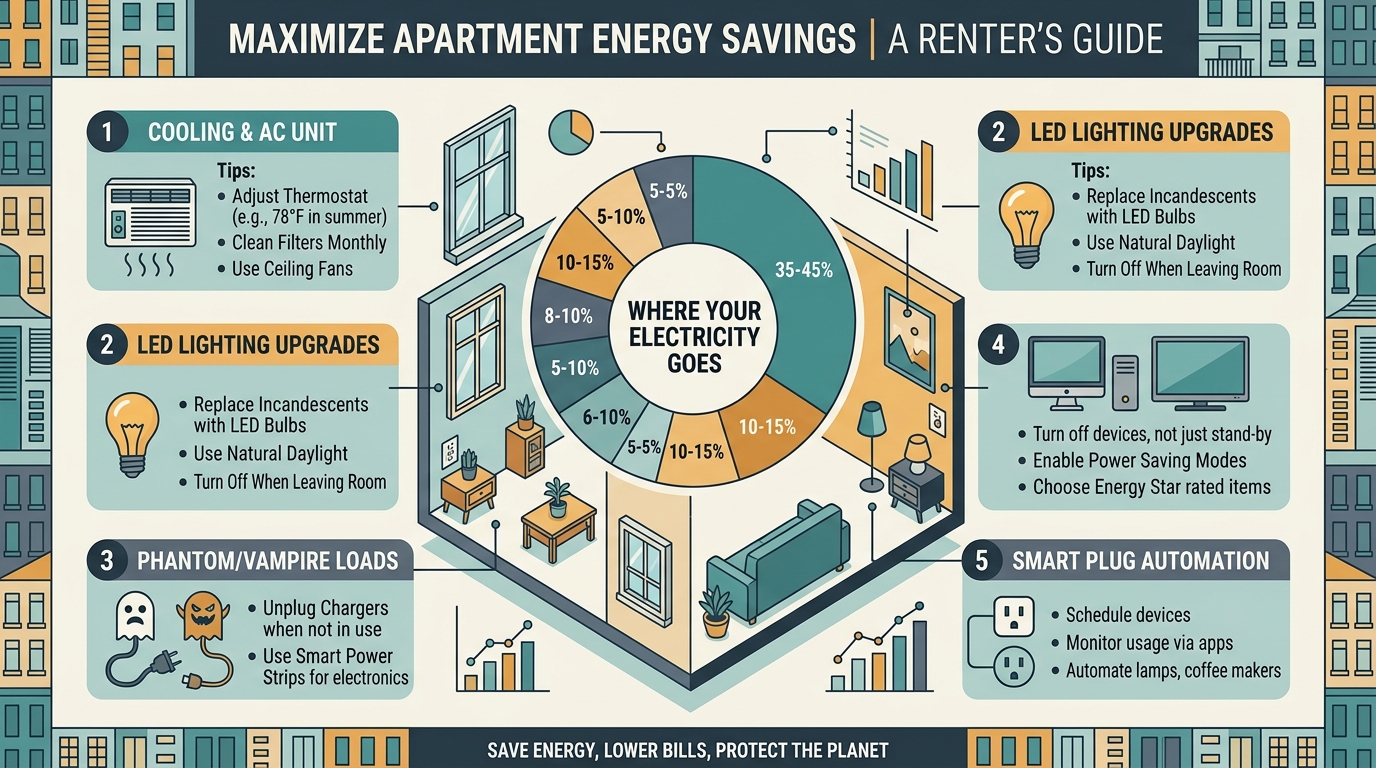
Where your apartment electricity bill actually goes — and where to cut
Quick Summary: The Renter’s Savings Playbook
If you’re short on time, here’s the entire strategy:
| Chapter | Focus | Typical Savings | Upfront Cost |
|---|---|---|---|
| 1. Measure | Find your biggest energy hogs | (enables everything else) | ~$25 |
| 2. Understand | Read your bill, catch errors | $50–$200 | $0 |
| 3. Eliminate | Kill vampire power | $100–$400 | $12–$35 |
| 4. Replace | Switch incandescent bulbs to LED | $100–$300 | $40–$70 |
| 5. Automate | Smart plugs for 24/7 devices | $50–$200 | $12–$25 |
| 6. Optimize | Cooling and heating strategy | $65–$200 | Varies |
| 7. Act | 30-day action plan | — | — |
Total realistic savings: $300–$900/year. Typical upfront investment: $100–$150. Payback period: 2–6 months.
Bottom line: Renters have more control over their electricity bill than they think. It just requires a systematic approach — measure, understand, eliminate, replace, automate, optimize.
Now let’s break it down chapter by chapter.
Chapter 1: Measure Before You Save — The Kill A Watt Method
Here’s the mistake 95% of renters make: they try to save money on electricity without knowing where their electricity actually goes.
They buy smart plugs for devices that cost $2/year. They unplug phone chargers that cost $0.50/year. They spend $50 and save $5.
The fix is simple: measure first.
The Only Tool You Need
The P3 P4400 Kill A Watt is a plug-in electricity usage monitor. You plug it into a wall outlet, plug an appliance into it, and let it run for 24 hours. The meter tells you exactly how much energy that appliance uses — and, by extension, exactly how much it costs you per year.
It costs about $25. It requires zero installation. It works in any apartment. And it replaces guessing with data.
P3 P4400 Kill A Watt Electricity Usage MonitorThe 5-Step Measurement Process
- List your 10 most-used appliances — focus on devices that run 24/7 first (cable box, router, refrigerator, gaming console, computer)
- Plug the Kill A Watt into the wall — use a wall outlet, not a power strip
- Plug the appliance into the Kill A Watt — press Reset to zero the meter
- Let it run for 24 hours — this captures the full daily cycle
- Read the KWH and Hr buttons — calculate:
KWH × Your Rate × 365= annual cost
What You’ll Typically Find
Based on hundreds of renter audits, the pattern is almost always the same: the top 3 appliances account for 80% of your wasted energy.
| Appliance | Typical Annual Cost | Priority |
|---|---|---|
| Set-top box (cable/satellite) | $130 | 🔴 High |
| Old second refrigerator | $50–$100 | 🔴 High |
| Gaming console (standby) | $30–$50 | 🔴 High |
| Desktop computer (sleep mode) | $28 | 🟡 Medium |
| Coffee maker (keep-warm) | $15–$20 | 🟡 Medium |
| Inkjet printer (standby) | $10–$15 | 🟡 Medium |
| Microwave (digital clock) | $3–$5 | 🟢 Low |
Once you know your top 3, you know exactly where to focus.
🛒 Get the Kill A Watt on Amazon📖 Deep dive: For the complete step-by-step tutorial — including room-by-room audit templates and a full apartment walkthrough — read our How to Use a Kill A Watt Meter guide.
Chapter 2: Understand Your Bill — And Catch Errors Before You Pay
You can’t fix what you don’t understand. And most renters don’t actually understand their electricity bill — they just pay it.
That’s a problem, because billing errors are more common than you’d think. Estimated readings, unmetered fees, submetering markups, and rate changes without notice can silently inflate your bill by $200–$500 per year.
The 5 Components of Every Electricity Bill
- Customer Charge ($5–$15/month) — fixed fee for being connected. Applies even if you use zero electricity.
- Energy Charge ($0.10–$0.35/kWh) — the actual electricity you consumed. This is the part you control.
- Delivery Charge ($0.03–$0.08/kWh) — cost of delivering power to your apartment. Sometimes bundled with energy, sometimes separate.
- Taxes and Regulatory Fees (5–15% of total) — non-negotiable, but a good sanity check.
- Adjustments and Credits — one-time charges or credits that distort your bill.
The Red Flags to Watch For
| Red Flag | What It Means |
|---|---|
| Unexplained usage spike (30%+) | A faulty appliance running 24/7, or a meter issue |
| “Estimated Reading” instead of “Actual” | You may be overpaying — request an actual meter reading |
| Fees you don’t recognize | Verify against your state’s PUC rules on submetering |
| Rate change without notice | Most states require advance notice — this may be an error |
| Zero usage for a month | Possible meter malfunction — document everything |
How to Calculate Your Daily Cost
Find your total kWh for the month, divide by days in the billing cycle, then multiply by your rate:
750 kWh ÷ 30 days = 25 kWh per day 25 kWh × $0.15 = $3.75 per day $3.75 × 365 = $1,369 per year
That’s your baseline. Now you know what you’re trying to reduce.
📖 Deep dive: For a full breakdown of rate structures (flat, tiered, time-of-use, submetered) and detailed guidance on when to escalate to your landlord, read our How to Read Your Apartment Electricity Bill guide.
Chapter 3: Eliminate Vampire Power — The 7 Hidden Loads
Vampire power (also called phantom load or standby power) is electricity consumed by devices that are “off” but still plugged in. According to the U.S. Department of Energy, it accounts for 5–10% of a typical household’s annual electricity use.
For renters, that’s $250–$400 wasted every year on devices you’re not even using.
The 7 Biggest Culprits
| Device | Annual Cost | Renter-Friendly Fix |
|---|---|---|
| Set-top box (cable/satellite) | $130 | Smart plug with scheduling |
| Old second refrigerator | $50–$100 | Check lease — may be removable |
| Gaming console (PS5/Xbox standby) | $30–$50 | Power settings + smart plug |
| Desktop computer (sleep mode) | $28 | Shutdown habit |
| Coffee maker (keep-warm) | $15–$20 | Manual switch |
| Inkjet printer (standby) | $10–$15 | Advanced power strip |
| Microwave (digital clock) | $3–$5 | Low priority — skip |
Total: $250–$400/year. Focus on the top 3 first.
The Renter-Friendly Toolkit
Three tools solve 90% of vampire power problems:
- Smart plug with energy monitoring — schedules automatic shutdown for 24/7 devices (cable box, gaming console)
- Advanced power strip — master-controlled strip that cuts power to peripherals when your computer or TV is off
- Kill A Watt meter — measures which devices are actually expensive (see Chapter 1)
🛒 Check Kasa KP405 Price on Amazon📖 Deep dive: For the complete list of vampire power culprits with sources, plus how each one can be safely scheduled, read our Vampire Power in Rentals guide.
Chapter 4: Replace Inefficient Bulbs — The Biggest Quick Win
This is the single highest-ROI upgrade available to any renter. Not because it saves the most money, but because it’s the cheapest, fastest, and most reversible change you can make.
Why LEDs Win
- 80–90% less energy than incandescent bulbs
- 10–25× longer lifespan (15,000–25,000 hours vs. 1,000)
- Payback period: 2–5 months
- Fully portable — you take them when you move
The Math
A typical apartment has 15–20 light bulbs. If they’re incandescent (60W each), switching to LEDs (8–9W) saves roughly:
- 15 bulbs: $137/year
- 18 bulbs: $307/year (home office renter)
- 20 bulbs: $685/year (high-rate renter)
The #1 Renter Pick
The Philips LED Selectable White A19 is the best bulb for renters because:
- One SKU, five color temperatures — tune from 2700K (warm) to 5000K (daylight) with a simple switch. No need to buy different bulbs for different rooms.
- Dimmable, flicker-free, high CRI
- $2–$4 per bulb in multi-packs
- 15,000-hour lifespan
For bathroom vanities and chandeliers, add the Philips Candelabra E12. For smart scheduling, consider the Philips Hue Starter Kit.
Philips LED 75W A19 Selectable White (5-CCT: 2700K–5000K), 4-Pack 🛒 Check Philips Selectable White on Amazon📖 Deep dive: For the full room-by-room LED plan (which color temperature for which room), plus a complete shopping list for a 1-bedroom apartment, read our Best LED Bulbs for Renters guide.
Chapter 5: Automate with Smart Plugs — Let the Tech Do the Work
Once you know which devices are your biggest energy hogs (Chapter 1), and you’ve eliminated the obvious ones (Chapter 3), the next step is automation.
Smart plugs let you:
- Schedule devices to power off automatically
- Monitor real-time energy consumption
- Control devices remotely via app or voice
- Verify that your changes actually reduced consumption
The Renter-Friendly Smart Plug Picks
| Category | Product | Best For |
|---|---|---|
| Best Overall | Kasa Smart Plug KP405 | Energy monitoring + compact design |
| Best Budget | Wyze Plug (2-Pack) | Basic scheduling on a budget |
| Best for Narrow Outlets | Kasa Smart Plug Mini EP10 | Doesn’t block second outlet |
| Best Multi-Pack | Emporia Smart Plug (4-Pack) | Full apartment audit |
The One Rule
Only automate devices that can safely tolerate scheduled power cuts. Cable boxes with DVR functions need continuous power. Space heaters should never be plugged into standard smart plugs. When in doubt, don’t automate — use a manual switch or leave the device alone.
Kasa Smart Plug KP405 (Energy Monitoring)📖 Deep dive: For the complete comparison of smart plugs for renters — including outlet fit, energy monitoring accuracy, and device-by-device recommendations — read our Best Smart Plugs for Apartments guide.
Chapter 6: Optimize Cooling and Heating — The Seasonal Wildcard
Cooling and heating are typically the largest seasonal swings in your electricity bill. For renters, the decision is rarely “what’s the best system” — it’s “what can I actually install without violating my lease.”
The Core Trade-Off
| Factor | Portable AC | Window AC |
|---|---|---|
| Cooling Speed | Slower | Faster |
| Energy Use | ~0.88 kWh/hour | ~0.43 kWh/hour |
| Upfront Cost | $300–$700 | $150–$500 |
| Seasonal Running Cost | +$52 more | Lower |
| Lease Risk | Very low | Moderate |
| Best For | Awkward windows, strict leases | Standard windows, long-term cooling |
The Bottom Line
- If your lease allows a window AC → window unit wins on efficiency ($65–$85 savings per season)
- If your window is awkward or lease is strict → portable AC is the safer renter choice
- If you must go portable → look for a dual-hose inverter model (Midea Duo) — closest to window AC efficiency
📖 Deep dive: For the complete physics explanation, cost breakdown over 3 years, and a decision framework based on your specific lease and window type, read our Portable AC vs Window Unit guide.
Chapter 7: Your 30-Day Action Plan
Knowledge without action is useless. Here’s a concrete plan you can execute in the next 30 days.
Week 1: Diagnose
- Buy a Kill A Watt meter (~$25)
- List your 10 most-used appliances
- Measure one appliance per day (24 hours each)
- Build your “Energy Hog” list with annual costs
Week 2: Understand & Eliminate
- Pull your last 3 electricity bills — compare usage
- Identify your rate structure (flat, tiered, TOU)
- Check for red flags (estimated readings, unfamiliar fees)
- Unplug or schedule your top 3 vampire loads
Week 3: Replace & Automate
- Count all light bulbs in your apartment
- Order LEDs (Philips Selectable White for E26, Candelabra E12 for vanities)
- Install LEDs — save original bulbs in labeled bags for move-out
- Buy 1–2 smart plugs (Kasa KP405 for energy monitoring)
- Schedule your entertainment center and coffee maker
Week 4: Optimize & Verify
- Review AC/heating strategy for the season
- Seal gaps around portable AC windows (weatherstrip)
- Compare your next electricity bill to the previous month
- Adjust your plan based on real data
Expected Results
If you execute all four weeks, here’s what you’ll typically see:
| Action | Annual Savings |
|---|---|
| Eliminate vampire power (top 3) | $150–$200 |
| Switch to LEDs | $100–$300 |
| Automate 24/7 devices | $50–$100 |
| Optimize cooling/heating | $65–$200 |
| Total | $300–$900/year |
Upfront investment: ~$100–$150. Payback: 2–6 months.
What Makes Renter Energy Savings Different
The advice in this guide differs from typical “save energy” articles because it’s built around renter constraints:
| Constraint | Renter-Friendly Solution |
|---|---|
| Can’t rewire fixtures | Swap bulbs only — LEDs are fully portable |
| Can’t replace landlord appliances | Measure first; only replace what you own |
| Can’t install solar | Focus on consumption reduction, not generation |
| May move in 12 months | Only invest in portable, high-payback tools |
| Can’t modify the property | Smart plugs, power strips, adhesive LED strips |
| Strict lease / HOA rules | Portable AC, no-drill weatherstripping, window kits |
Every recommendation in this guide is:
- ✅ Portable — you take it when you move
- ✅ Reversible — no permanent changes
- ✅ Renter-safe — no lease violations
- ✅ High-ROI — payback in months, not years
Common Renter Mistakes (And How to Avoid Them)
Mistake #1: Buying smart plugs before measuring. You might spend $50 automating 6 devices that save $30/year. Measure first, then automate the top 3.
Mistake #2: Assuming all vampire loads are worth fixing. A microwave clock costs $3/year. Unplugging it saves more in effort than in dollars. Focus on the top 3.
Mistake #3: Leaving original bulbs at the store. When you swap to LEDs, save the landlord’s original bulbs in labeled ziplock bags. This protects your security deposit.
Mistake #4: Buying a portable AC before checking your window type. Casement windows can’t fit a window AC. Always check the window compatibility matrix before buying.
Mistake #5: Ignoring your electricity bill. A 5-minute monthly review can catch billing errors worth $200–$500/year. It’s the highest-ROI habit in this entire guide.
Frequently Asked Questions
How much can a renter realistically save on electricity?
Based on DOE and NRDC data, the average renter can save $300–$900 per year by applying the strategies in this guide. Realistic middle-ground savings: $300–$500/year for most renters who execute the 30-day plan.
What’s the single highest-ROI upgrade for renters?
LED bulbs. A 30-second swap with a 2–5 month payback, fully portable, no lease risk. Typical savings: $100–$300/year depending on how many bulbs you replace.
Do I need landlord permission to make these changes?
No. Every recommendation in this guide is renter-safe:
- LED bulbs — routine maintenance, not a modification
- Smart plugs — plug into existing outlets, no installation
- Portable AC — window kit is removable
- Weatherstripping — temporary, removable
- Kill A Watt meter — measurement tool, not a modification
The one exception: window AC units may require landlord approval depending on your lease.
What if my utilities are included in rent?
You still benefit from reduced consumption because:
- Landlords often factor utility costs into rent — lower usage = negotiating power at renewal
- You may still be charged for excessive usage above a baseline
- Good habits transfer to your next apartment
How long until I see results?
Immediate for LEDs and vampire power (next bill). Slower for AC optimization (seasonal). Most renters see measurable savings within the first 30–60 days.
What’s the best order to do these upgrades?
- Measure first (Kill A Watt)
- Fix billing issues (read your bill)
- Kill obvious vampire loads (unplug what you can)
- Swap to LEDs (biggest quick win)
- Automate with smart plugs (long-term savings)
- Optimize cooling/heating (seasonal)
Can I do this if I’m moving in 6 months?
Yes — everything in this guide is portable:
- LED bulbs → unscrew and take
- Smart plugs → unplug and take
- Kill A Watt → keep forever
- The knowledge → travels with you
Payback periods range from 2–6 months, so even a 6-month stay breaks even.
Your Next Step
You now have the complete renter energy savings playbook. The question isn’t whether you can save money on your apartment electricity bill — it’s whether you’ll take the first step.
Start with measurement. Buy a Kill A Watt, list your appliances, and measure one per day for the next 10 days. By day 11, you’ll have a personalized savings plan worth $300–$900/year — for a $25 investment and 30 minutes of your time.
🛒 Start Measuring — Check Kill A Watt on AmazonReady to start? The P3 P4400 Kill A Watt is the same tool professional energy auditors use. It pays for itself in the first month of measurement.
If you’d rather jump directly into a specific area, pick the article that matches your priority:
- Measure your usage: How to Use a Kill A Watt Meter
- Understand your bill: How to Read Your Apartment Electricity Bill
- Kill vampire power: Vampire Power in Rentals
- Switch to LEDs: Best LED Bulbs for Renters
- Automate savings: Best Smart Plugs for Apartments
- Optimize cooling: Portable AC vs Window Unit
About This Article
WattDweller is a reader-supported publication dedicated to helping renters reduce energy costs without permanent modifications.
For information about how we develop and review content, see our Editorial Policy.
Sources: Energy information cited in this article comes from the sources linked throughout the article, including the U.S. Department of Energy (DOE), ENERGY STAR, the Natural Resources Defense Council (NRDC), the U.S. Energy Information Administration (EIA), and Lawrence Berkeley National Laboratory.
Last Updated: September 25, 2026
Related reading
- Achieve Energy Independence: DIY Solar, Wind, and Alternative Energy Solutions
- Portable Power Stations: The Complete Buyer’s Guide for Home Backup and Off-Grid Living
- The Ultimate Guide to Smart Plugs: Automate, Save Energy, and Lower Your Bills
- How to Use a Kill A Watt Meter: The Renter’s Guide to Finding Energy Hogs
- How to Read Your Apartment Electricity Bill (And Spot Overcharges Before You Pay)
- Vampire Power in Rentals: 7 Hidden Devices Quietly Inflating Your Electricity Bill
- Best LED Bulbs for Renters: Brighten Your Apartment Without Rewiring
- Best Smart Plugs for Apartments: Energy Monitoring, Scheduling & No Wiring
- Portable AC vs Window Unit: Which Is Better for Renters?